Did you know that choosing the right roofing material could pay for itself in as little as four years through insurance savings alone? In Central Arkansas, we all know that a heavy hail storm isn’t a matter of “if” but “when.” It’s frustrating to watch your insurance premiums climb every year while worrying if your roof will survive the next spring season. When you’re weighing the benefits of class 3 vs class 4 shingles, you want a solution that stands strong against the elements without making the decision feel more complicated than it needs to be.
This guide clears up the confusion surrounding these impact-resistant materials so you can protect your home and your wallet. You will discover the critical differences in durability and how the 2026 Strengthen Arkansas Homes Act changes the financial landscape for local homeowners. We’ll show you how to secure a roof that lasts over 20 years and potentially reduces your insurance premiums by up to 35 percent. By the end, you’ll have the confidence to choose the best protection for your property and enjoy the peace of mind that comes with a job well done.
Key Takeaways
- Understand the UL 2218 testing standard to see how “steel ball tests” simulate real-world hail damage on your roof.
- Compare the specific durability ratings of class 3 vs class 4 shingles to determine which level of protection fits your home’s needs.
- Learn why Arkansas weather patterns make impact-resistant materials a vital choice for homeowners in Little Rock, Benton, and Hot Springs Village.
- Analyze the cost-benefit ratio to see how a slightly higher upfront investment leads to significant insurance discounts and a longer-lasting roof.
- Discover how professional installation and proper attic ventilation ensure your premium shingles perform at their peak for decades.
Understanding Impact Resistance: The UL 2218 Testing Standard
When you begin researching a new roof for your home, you will quickly encounter terms like “impact resistant” and “UL 2218.” These aren’t just marketing buzzwords used by contractors. Since 1996, the roofing industry has relied on the UL 2218 Testing Standard to determine how well materials handle physical trauma. It’s a rigorous benchmark that simulates the harsh reality of an Arkansas spring. While wind ratings tell you if your shingles will blow off and fire ratings measure flame spread, impact resistance measures the ability to survive a direct hit from falling debris.
The distinction between these ratings is vital for your peace of mind. A roof might have a high wind rating but still fail during a hail storm if the material is too brittle. Understanding the mechanics of class 3 vs class 4 shingles helps you see why the testing process matters. The goal isn’t just to keep the roof looking pretty. It’s to ensure the structural integrity of your home remains intact after the clouds clear.
The Steel Ball Test Explained
To earn a rating, shingles undergo a specialized evaluation known as the steel ball test. During this process, engineers drop heavy steel balls from heights ranging from 12 to 20 feet directly onto the shingle surface. This procedure mimics the kinetic energy and terminal velocity of hail falling from the sky. The UL 2218 Testing Standard is the gold standard for measuring how asphalt shingles withstand physical impact.
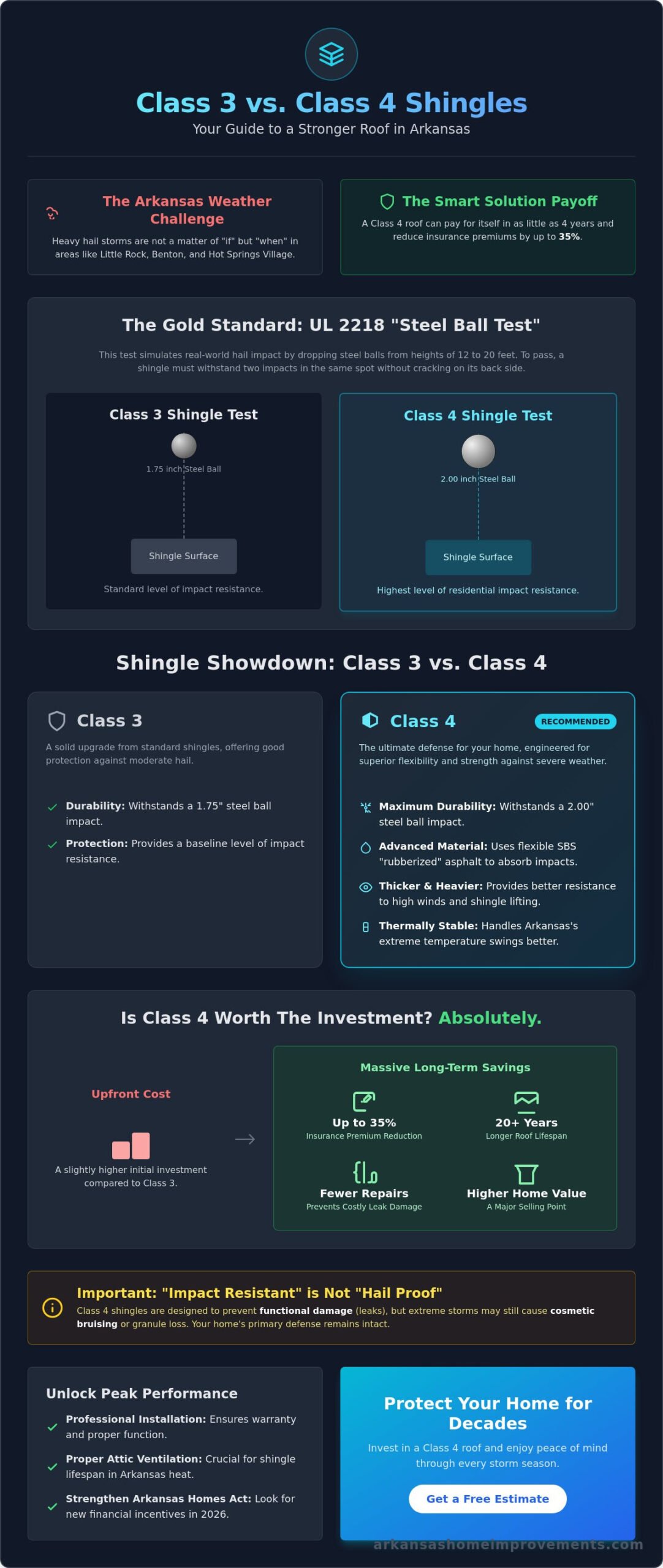
The criteria for passing are strict. A shingle must be hit twice in the same spot without showing any visible cracks, tears, or fractures on the backside. Many homeowners assume the front of the shingle is what matters most. In reality, testing labs flip the shingle over to look for microscopic damage. If the underside matting stays sealed, water cannot seep through to your roof deck. This is the primary difference between class 3 vs class 4 shingles; the class 4 shingle must survive a 2-inch steel ball, while class 3 only faces a 1.75-inch ball.
Why “Impact Resistant” Does Not Mean “Hail Proof”
We believe in being honest with our neighbors. It’s important to understand that “impact resistant” is not the same as “hail proof.” Nature is unpredictable. Even the highest-rated roofing materials can sustain damage during extreme weather events involving massive hail or high-velocity debris. However, these shingles are specifically engineered to prevent functional damage.
Functional damage occurs when the shingle’s ability to shed water is compromised. You might notice cosmetic bruising or a slight loss of granules after a storm. While this affects the look of your home, an impact-resistant shingle is designed to keep the underlying waterproof layer secure. This protection prevents the leaks that lead to costly interior repairs and mold growth. Choosing a higher class of shingle is about building a better line of defense for your family.
Class 3 vs. Class 4 Shingles: The Technical Comparison
Comparing class 3 vs class 4 shingles requires looking beneath the surface at how these materials are manufactured. While they might look similar from the ground, their internal chemistry and physical resilience differ significantly. Class 3 shingles are tested to withstand a 1.75-inch steel ball drop, which serves as a solid baseline for many homes. However, Class 4 shingles are engineered to survive a 2-inch steel ball drop, representing the highest level of protection available for residential properties.
The secret to the superior performance of Class 4 materials often lies in Styrene-Butadiene-Styrene (SBS) modified bitumen. This is essentially a rubberized asphalt that gives the shingle a “memory” effect. When a heavy object strikes the surface, the material flexes and absorbs the energy instead of cracking or tearing. This flexibility is a major reason why many experts recommend an impact-resistant roof for families living in storm-prone regions.
You will also notice a difference in physical presence and weight. Class 4 shingles are generally thicker and heavier than their Class 3 counterparts. This added mass provides several benefits:
- A sturdier barrier against high-velocity winds.
- Better resistance to shingle lifting or curling over time.
- Improved thermal stability during Arkansas’s extreme temperature swings.
If you are curious about how these heavier materials might affect your specific home structure, our team can help you understand how long a roof lasts in Arkansas when using these premium materials.
Class 3 Shingles: The “Standard Plus” Option
Class 3 shingles serve as an excellent middle ground for homeowners who want more than basic protection. These are typically found in high-quality architectural lines and offer a significant durability boost over traditional 3-tab shingles. They are best suited for areas where hail is infrequent and usually small in diameter. They provide a reliable shield for your home without the premium price tag of the top-tier options.
Class 4 Shingles: The Premium Protection Tier
Choosing the premium tier means investing in advanced rubberized asphalt technology. This allows the shingle to literally “bounce back” from severe impacts that would shatter standard materials. These shingles also feature enhanced granule adhesion, which is vital for preventing UV damage after a storm has scoured the surface. Class 4 shingles are designed to survive 2-inch hail, which is roughly the size of a hen egg.
The Arkansas Factor: Why Local Weather Dictates Your Choice
Living in Central Arkansas means living with the constant threat of severe thunderstorms. Communities like Little Rock, Benton, and Hot Springs Village sit directly in a documented hail corridor, often referred to as the “Hail Alley” of the South. This geographical reality makes the decision between class 3 vs class 4 shingles a strategic investment rather than a simple aesthetic choice. When the sky turns green and the sirens sound, the physical resilience of your roofing material determines whether you’ll be dealing with minor cleanup or a total loss.
The frequency of these storms impacts the overall longevity of roofs across our state. While a roof in a milder climate might last its full rated lifespan, Arkansas roofs face a unique set of challenges that accelerate wear and tear. High-impact weather events combined with our local humidity cycles mean that standard shingles often fail long before their time. Choosing a higher class of impact resistance is the most effective way to ensure your home remains a safe haven for your family.
Central Arkansas Hail Trends
Pulaski and Saline counties historically experience some of the most frequent storm activity in the region. Our spring and fall seasons are particularly brutal because they bring rapid temperature shifts that create large, high-velocity hail. These storms don’t just happen once a decade; they’re a seasonal expectation. Beyond the visible impact of hail, the intense Arkansas heat and humidity create a punishing environment for roofing materials. This constant cycle of heating and cooling causes shingles to expand and contract, which can lead to premature brittleness. Impact-resistant materials are specifically designed to maintain their flexibility under these local conditions.
Insurance Discounts for Arkansas Homeowners
The financial benefits of upgrading to premium materials are significant for local families. Most Arkansas insurance carriers offer premium discounts ranging from 10% to 35% for homes with Class 4 shingles. These savings are no longer just a suggestion. As of January 1, 2026, the Strengthen Arkansas Homes Act mandates that insurance companies provide discounts for homes certified to resilient standards. This legislative shift recognizes that a stronger roof reduces the likelihood of costly claims for everyone involved.
A Class 4 roof often pays for its own price premium through these insurance savings in just four to eight years. When our team handles a hail damage roof replacement in Arkansas, we prioritize the paperwork just as much as the shingles. We provide a formal “Certificate of Installation” that you can submit to your insurance agent. This document serves as verifiable proof of your upgrade, ensuring you lock in the maximum available discounts and protect your home’s value for years to come.
Cost-Benefit Analysis: Is Class 4 Worth the Investment?
Deciding between class 3 vs class 4 shingles often comes down to the bottom line. While a Class 4 roof typically costs 10% to 20% more than a Class 3 installation, the initial price tag is only one part of the financial picture. You have to look at the long-term value to understand which choice truly saves you money. In a state where severe weather is a seasonal certainty, the extra investment in premium materials acts as a hedge against future repair bills and rising insurance costs.
One of the most immediate financial benefits is the potential to avoid your insurance deductible. Most Arkansas homeowners carry deductibles ranging from $1,000 to $5,000. If a standard roof suffers hail damage, you are out of pocket for that full amount before the insurance company pays a dime. By installing a more resilient surface, you significantly reduce the likelihood of filing a claim in the first place. This protection also enhances your property’s resale value, as savvy buyers in Central Arkansas specifically look for impact-rated roofs to keep their own future premiums low.
Longevity is another critical factor in your ROI. You can learn more about how long a roof lasts in Arkansas when you choose materials designed to withstand our specific climate. While a standard roof might struggle to reach its 20-year mark due to storm wear, a Class 4 system is built to go the distance.
Calculating the Return on Investment (ROI)
When you factor in insurance discounts over a 15-year period, the math usually favors the upgrade. Many local families find that the annual premium savings completely offset the higher installation cost within the first decade. There is also the “peace of mind” factor to consider. You won’t have to join the frantic cycle of searching for a contractor alongside thousands of other homeowners immediately after a major storm hits your neighborhood. While Class 4 costs more today, it often results in the lowest total cost of ownership over the life of the roof.
When Class 3 Might Be Sufficient
There are specific scenarios where Class 3 shingles remain a practical choice. If you own a rental property or a short-term holding where you don’t plan to capture long-term insurance savings, the lower upfront cost might make sense. Some homes also benefit from significant tree canopy protection that naturally mitigates the force of falling hail. However, if you are looking for even higher levels of protection beyond asphalt, you might want to compare these options to metal roof vs shingles Arkansas homeowners consider for ultimate durability.
If you are ready to see how these numbers look for your specific property, contact Arkansas Home Improvement for a professional evaluation of your roofing needs.
Choosing the Right Shingle with Arkansas Home Improvement
Selecting the right material is only half the battle. You need an experienced hand to ensure those shingles perform as intended during a storm. Steve and the team at Arkansas Home Improvement take a methodical approach to every project. We don’t just look at the shingles; we evaluate your entire roofing system. This includes a thorough check of your attic ventilation and the condition of your roof deck. If the underlying structure isn’t sound, even the best impact-resistant shingles can’t do their job effectively. We prioritize your peace of mind by ensuring every component of your roof is ready for the next season of severe weather.
Our recommendation for most homeowners in Little Rock and Benton is clear. Given the frequency of hail and the newly mandatory insurance discounts, the debate between class 3 vs class 4 shingles usually ends with Class 4 as the superior choice. It provides the most robust defense for your family and ensures you aren’t left behind as building standards and insurance requirements evolve across the state. We’re here to help you navigate these technical choices so you can feel confident in the longevity of your investment.
Expert Installation in Central Arkansas
High-performance shingles require high-performance installation techniques. We use the specific nail patterns and heavy-duty starter strips required for high-wind and high-impact ratings. Cutting corners during installation can actually void your manufacturer’s warranty or prevent you from receiving insurance discounts. We take immense pride in our workmanship and provide all the documentation your insurance carrier needs to verify your upgrade. If you’re still vetting your options, we encourage you to read our guide on how to choose a roofing contractor in Arkansas to see what sets a professional team apart.
Protect Your Home Today
The choice between Class 3 and Class 4 is about more than just a label. It’s about securing your home against the unpredictable nature of Arkansas weather while making a smart financial move. Whether you’re looking for a reliable standard or the ultimate in rubberized asphalt protection, we’re here to help you navigate the process. We invite you to reach out for a free roof inspection and a personalized impact-resistance consultation. Our goal is to give you confidence in your roof for the next 20 years and beyond. Schedule your professional roofing installation in Central Arkansas today and experience the peace of mind that comes with a job done right.
Build a More Resilient Home for Your Family
Choosing between class 3 vs class 4 shingles is one of the most important decisions you’ll make for your property’s long-term health. While Class 3 offers a solid baseline, Class 4 provides the rubberized durability needed to survive Central Arkansas hail seasons year after year. This upgrade doesn’t just protect your roof; it secures your financial peace of mind through lower insurance premiums and fewer out-of-pocket deductible payments as the years go by.
Arkansas Home Improvement brings over 15 years of service to every project in our community. Steve and our team are locally owned and operated, maintaining an A+ reputation for storm damage restoration across the region. We understand the specific challenges of our local climate and are committed to helping you navigate every insurance requirement with ease. We take pride in delivering consistent quality that stands up to the toughest weather.
Get a Free Estimate on Class 4 Impact-Resistant Shingles today to ensure your home stays dry and protected for decades to come. We look forward to helping you make the best choice for your home and your family.
Frequently Asked Questions
Do Class 4 shingles really lower my insurance in Arkansas?
Yes, they do. Many Arkansas insurance carriers offer significant premium discounts for homes with impact-resistant materials. Under the 2026 Strengthen Arkansas Homes Act, insurance companies must offer these discounts for homes that meet certified resilient standards. Homeowners often see their annual premiums reduced by 10% to 35%, helping the roof pay for itself over time.
Can you tell the difference between Class 3 and Class 4 shingles by looking at them?
You usually cannot tell the difference from the ground once they are installed. The primary physical distinctions between class 3 vs class 4 shingles are the thickness and the internal chemical composition. Class 4 shingles are typically heavier and feel more flexible because they contain rubberized SBS asphalt. To verify the rating, you must look for the manufacturer’s stamp on the packaging or the underside of the shingle.
What happens if hail larger than 2 inches hits a Class 4 shingle?
Hail larger than 2 inches can still cause damage to a Class 4 shingle. These materials are tested to survive impacts from 2-inch steel balls without cracking or tearing the underlying matting. If a storm produces massive hail, you might see cosmetic bruising or a loss of granules. However, the reinforced construction is much more likely to remain waterproof compared to standard shingles.
Are Class 4 shingles heavier than Class 3, and does my roof need reinforcement?
Class 4 shingles are heavier, but most modern Arkansas homes do not require any extra structural reinforcement. Standard roof framing is designed to handle the weight of heavy architectural shingles without issue. During our initial inspection, our team evaluates the condition of your roof deck and rafters. We ensure your home’s structure is sound before we begin the installation process.
How much more do Class 4 shingles cost on an average home in Little Rock?
Upgrading to Class 4 shingles typically adds 10% to 25% to the total cost of a standard roof replacement. While the upfront investment is higher, it is a strategic financial move for local property owners. When you compare class 3 vs class 4 shingles, the premium option often leads to the lowest total cost of ownership because of insurance savings and a reduced need for storm-related repairs.
Does a Class 4 rating guarantee that my roof will not leak after a storm?
No rating provides an absolute guarantee against leaks, but it significantly lowers the risk of functional failure. A leak-free roof depends on the entire system, including high-quality underlayment, proper flashing, and correct attic ventilation. While the shingles themselves are harder to puncture, professional installation is what ensures the whole system remains watertight during a severe Arkansas thunderstorm.
Which brands offer the best Class 3 and Class 4 shingle options?
Several leading manufacturers produce high-quality shingles that meet the UL 2218 impact resistance standard. We recommend choosing a brand that utilizes SBS-modified asphalt for maximum flexibility and granule retention. During our professional consultation, we help you compare options from major industry providers to find the material that offers the best balance of durability and aesthetic appeal for your home. If you are weighing whether to go beyond asphalt entirely, our detailed breakdown of metal roof vs shingles for Arkansas homeowners can help you evaluate all available options.