After the July 7, 2026 storm moved through Hot Springs, many homeowners found themselves back on the phone with insurance adjusters for the third time in five years. It’s frustrating to watch your deductible climb while your shingles lose their protective granules with every spring thunderstorm. You deserve better than a cycle of constant repairs and the stress of wondering if the next cell over Hot Springs Village will finally be the one that causes a total loss. Finding the best roof for hail in Arkansas is no longer just about curb appeal. It’s about long-term stability and finally qualifying for those mandatory insurance discounts that went into effect on July 1, 2026.
We understand that you want a home that stands strong against the local hail belt without draining your savings on premiums. This 2026 guide will show you which materials actually survive 1.5 inch hail and how the new Strengthen Arkansas Homes Act grants can help cover your upgrade. You’ll discover how to choose a Class 4 system that provides peace of mind for the next 30 to 50 years. We will break down the latest standards so you can make an informed decision for your family’s safety.
Key Takeaways
- Identify the UL 2218 impact ratings that define the best roof for hail in Arkansas to qualify for mandatory insurance discounts of up to 35%.
- Compare the performance of Class 4 shingles and metal roofing to see which material offers the longest lifespan in the Central Arkansas hail belt.
- Discover how the 2026 Strengthen Arkansas Homes Act offers grants of up to $15,000 to help you upgrade your roof’s storm resistance.
- Learn why the specific topography and tree canopy in Hot Springs Village and near Lake Hamilton require specialized wind-load considerations.
- Find out how professional installation techniques for flashing and underlayment prevent the most common leak points after a major storm.
Understanding the Arkansas Hail Belt and UL 2218 Ratings
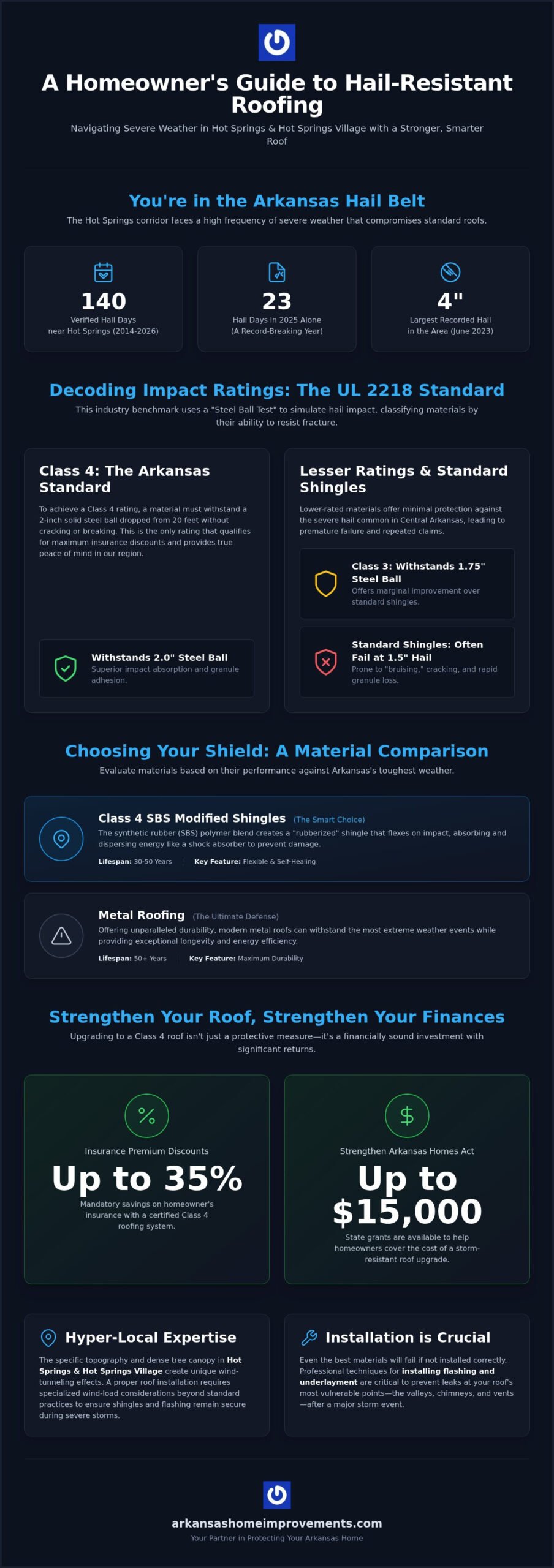
Central Arkansas, particularly the corridor including Hot Springs and Hot Springs Village, sits directly in what professionals call the “Arkansas Hail Belt.” This region faces a high frequency of severe weather that can compromise a home’s structural integrity. Between 2014 and 2026, there were 140 verified hail days within 10 kilometers of Hot Springs. Understanding Hail Formation helps explain why these ice stones vary so much in size, from pea-sized nuisances to the 4-inch giants recorded in our area in June 2023. The most active year on record was 2025, with 23 hail days, proving that storm frequency is a major factor in local roof degradation.
To find the best roof for hail in Arkansas, homeowners must look at the UL 2218 rating. This industry benchmark uses a “Steel Ball Test” to simulate the force of falling ice. For a material to achieve a Class 4 rating, it must withstand a 2-inch steel ball dropped from 20 feet without showing signs of breakage or penetration. Standard architectural shingles often fail when facing 1.5-inch hail, like the storm that hit Hot Springs on July 7, 2026, because they lack the flexibility to absorb that kinetic energy.
To better understand how these ratings protect your home, watch this helpful video:
The Science of Impact Resistance
A hail strike doesn’t always cause an immediate leak. Often, it causes “bruising,” where the impact displaces the protective granules and weakens the underlying asphalt mat. While “hail-proof” is a myth, high-quality hail-resistant materials are designed to flex rather than crack. Your roof deck also plays a vital role here. A solid, well-attached deck provides the necessary support to ensure the shingles don’t flex too far and snap under pressure. This combination of a sturdy deck and a Class 4 shingle is the best roof for hail in Arkansas because it addresses both structural support and surface protection.
Arkansas Weather Patterns and Roof Longevity
The climate in Hot Springs and nearby Little Rock creates a double threat for roofing. Our intense summer UV exposure dries out shingles, making them brittle over time. When the spring storm cycles return, these weakened shingles are far more likely to fail. Even small, recurring hail events have a cumulative effect. They slowly strip away the granules that protect your home from the sun, shortening the life of a standard roof by years. Choosing a material rated for these specific conditions is the only way to ensure 30 to 50 years of protection despite the local weather volatility.
Class 3 vs. Class 4 Impact-Resistant Shingles
When searching for the best roof for hail in Arkansas, you’ll likely encounter the choice between Class 3 and Class 4 shingles. The difference lies in the UL 2218 impact test. A Class 3 shingle must withstand a 1.75 inch steel ball. A Class 4 shingle survives a 2 inch steel ball. In a region like Hot Springs, where 4 inch hail has been recorded, that extra resistance is vital. Class 3 shingles are often barely more expensive than standard options, but the insurance benefits are significantly lower. This makes Class 4 the standard choice for homeowners who want real protection and financial returns.
Most high-end Class 4 options use SBS modified asphalt. SBS stands for Styrene-Butadiene-Styrene. This is a synthetic rubber polymer blended into the asphalt mat. Standard shingles are stiff and brittle, but SBS shingles are rubberized. They act like a shock absorber. They disperse the energy of a hail strike across the surface rather than letting it crack the mat. This technology prevents the bruising that leads to leaks. It keeps the shingle’s structural core intact even after repeated strikes from spring storms.
The Benefits of SBS Modified Shingles
These rubberized shingles offer superior granule retention. This is essential because losing granules exposes the asphalt to the sun, which leads to fast degradation. In Hot Springs Village, where temperature swings can be dramatic, SBS shingles remain flexible even in near freezing weather. They also possess self-healing properties where the shingles can actually re-seal small surface indentations over time. This durability ensures your home stays protected through several seasons of severe weather. You can learn more about our roofing installation services to see which SBS options fit your home.
Insurance Discounts for Arkansas Homeowners
Investing in a Class 4 roof is a smart financial move. As of July 1, 2026, Arkansas law requires insurers to offer premium discounts between 20% and 35% for homes with IBHS FORTIFIED-certified roofs. This is a direct result of Arkansas’s official hazard mitigation efforts to reduce storm damage state-wide. Most insurers will require you to submit an Impact Resistant Roofing form signed by your contractor. With these discounts, the typical payback period for the higher cost of Class 4 shingles is between 6 and 10 years. This makes the upgrade a self-funding improvement for many residents in Central Arkansas.
Why Metal Roofing is the Ultimate Defense for Arkansas Homes
Metal roofing represents a significant step up in durability from even the highest-rated asphalt shingles. While Class 4 shingles are a reliable choice, metal provides a structural longevity that asphalt simply cannot match. It’s often considered the best roof for hail in Arkansas because it shifts the focus from simple survival to long-term performance. Metal rarely breaches. This means that even if a stone is large enough to leave a mark, it won’t crack the material and allow water into your home. This level of security is essential for residents in the central hail belt who are tired of the post-storm repair cycle.
Homeowners must understand the “dent vs. breach” debate when choosing their materials. A large hailstone might leave a cosmetic dent on a metal panel, but it almost never compromises the roof’s ability to shed water. In contrast, the same hailstone would likely shatter the mat of a standard shingle. We recommend checking the UL 2218 impact resistance standard to see how different metal thicknesses are tested against these high-velocity impacts. This data helps explain why metal remains the top choice for those prioritizing peace of mind.
Standing Seam vs. Screw-Down Metal Panels
The method of attachment is just as important as the material itself. Screw-down panels, or exposed fastener systems, use thousands of screws that pierce the metal. Over time, the rubber washers on these screws degrade due to UV exposure. When hail hits or wind pulls at the panels, these fasteners can back out or become leak points. Standing seam metal uses hidden fasteners and interlocking ribs. This design allows the metal to glide during thermal expansion as temperatures rise in Hot Springs. It provides a sleek, modern look that enhances curb appeal in premier neighborhoods like Hot Springs Village while offering the most robust protection available.
Longevity and Heat Reflection
Metal roofs excel at reflecting solar radiation back into the atmosphere. This reflection keeps your attic significantly cooler and reduces the strain on your air conditioning during 100-degree August days. This efficiency is a massive benefit if you have a home generator installation Arkansas families rely on during summer power outages. A cooler home requires less energy to maintain a comfortable temperature when running on backup power. For a deeper look at how these systems perform in our climate, read our full guide on Metal Roofing Arkansas.
Selecting the Right Roof for Hot Springs and Hot Springs Village
Selecting the best roof for hail in Arkansas requires a deep understanding of Garland County’s unique geography. In Hot Springs Village, the dense tree canopy and rolling hills of the Ouachita Mountains change how storms behave. Falling branches often accompany hail events, which means your roofing material needs to handle both impact and weight. Additionally, homes near the open waters of Lake Hamilton or Lake Ouachita face higher wind-load pressures. These gusts can lift the edges of standard shingles, making them vulnerable to the next round of ice.
Aesthetics also play a major role in these communities. Many homeowners prefer earth tones that blend into the natural mountain backdrop. However, you must balance these looks with the strict Residential Rules and Regulations updated on March 25, 2026, in Hot Springs Village. These rules mandate proper maintenance and specific material standards for all exterior property. Selecting a Class 4 shingle or standing seam metal roof ensures you meet these requirements while protecting your investment.
Storm Patterns in Garland County
The historical frequency of hail in the Hot Springs area is a primary concern for long-term safety. With 140 verified hail days recorded between 2014 and 2026, the risk is constant rather than occasional. After a significant event, like the 1.5-inch hail on July 7, 2026, debris management becomes critical. Large stones often strip granules and leaves into your drainage system. This is why professional Gutter Installation Services are vital to prevent water backup after a storm. Protecting your home in the Village means looking at the entire exterior as a unified defense system.
Comprehensive Coverage for Central Arkansas
While we prioritize our neighbors in Hot Springs, our team provides the same high standards to residents in Arkadelphia, Malvern, and Benton. Each area has its own challenges. For instance, homes in Little Rock and North Little Rock deal with the urban heat island effect. This localized heat can accelerate the aging of asphalt shingles, making them more brittle before hail season arrives. Choosing a contractor who understands these Central Arkansas weather nuances is the best way to ensure long-term satisfaction.
If you’re ready to upgrade your home’s protection, we’re here to help. View our expert roofing installation services to find the right fit for your property.
Professional Installation: Protecting Your Investment
Even if you invest in the best roof for hail in Arkansas, the material is only as good as the crew that installs it. Shingles that aren’t nailed correctly or flashing that’s poorly sealed will fail long before the next storm arrives. At Arkansas Home Improvement, Steve provides local oversight on every project to ensure our high standards are met. This commitment to quality is what separates a 15-year roof from one that lasts half a century. We focus on building a system that stands up to the specific pressures of the Central Arkansas climate.
Proper underlayment and flashing are the invisible heroes of a storm-resistant system. In areas like Hot Springs, where heavy rains often follow hail, these components prevent water from finding its way into your attic. We also prioritize attic ventilation. Without it, the intense heat of an Arkansas summer “cooks” your shingles from the inside. This heat makes the asphalt brittle and much more susceptible to impact damage when the spring storm cycle returns. A well-ventilated roof stays flexible and resilient for much longer.
The Installation Checklist
Our team follows a rigorous process designed for the local climate. We don’t just follow the minimum requirements; we exceed them to provide peace of mind for our neighbors in Hot Springs Village and beyond. Every detail matters when your home’s safety is on the line.
- Nailing Patterns: We use enhanced nailing patterns with six nails per shingle instead of the standard four. This ensures shingles stay put during the severe wind gusts that often precede hail.
- Ice and Water Shields: We place these protective membranes in valleys, along eaves, and around chimneys. This is vital for managing the moisture from Arkansas ice storms and heavy downpours.
- Post-Installation Inspection: Every job ends with a thorough walk-through. We check the alignment and seating of every panel to verify the system is ready for the next “hail belt” event.
Getting Started with a Free Inspection
It’s often hard to spot hail damage from the ground. Small bruises or hairline cracks in the asphalt mat might not leak today, but they’ll become major issues within a few seasons. Working with a local team for Professional Roofing Installation means you have an expert who knows exactly what to look for after a Garland County storm. We help you identify these hidden problems before they lead to expensive interior repairs.
If you’re unsure about the current state of your home, it’s best to act before the next spring cycle begins. You can read our guide on how to choose a roofing contractor Arkansas families can trust for reliable work. Our goal is to ensure your home remains a safe haven for decades to come, regardless of what the weather brings.
Secure Your Home Against the Next Arkansas Storm
Choosing the best roof for hail in Arkansas is about more than just stopping leaks; it’s about investing in the long-term safety and value of your property. We’ve explored how Class 4 impact-resistant shingles and standing seam metal systems provide the durability needed for the Central Arkansas hail belt. Whether you live in the wooded hills of Hot Springs Village or near the shores of Lake Hamilton, your home requires a system designed for high-wind loads and heavy impacts. Professional installation ensures these high-quality materials perform exactly as intended when the weather turns severe.
At Arkansas Home Improvement, we bring over 15 years of local experience to every project. Our team specializes in both metal and impact-resistant asphalt, maintaining an A+ reputation across Hot Springs and the surrounding areas. We understand the specific weather patterns of Garland County and the importance of professional oversight. Don’t wait for the next spring cycle to find the weak spots in your current system. Take the first step toward a more resilient home today and protect your family for the next 30 to 50 years.
Get a Free Hail-Resistant Roofing Estimate from Willis & Son Roofing and enjoy the peace of mind that comes with a job well done.
Frequently Asked Questions
Do impact-resistant shingles actually prevent hail damage?
Impact-resistant shingles don’t prevent all damage, but they significantly reduce the risk of structural failure. They’re designed to withstand impacts without cracking the underlying asphalt mat. This prevents leaks even if the surface looks bruised. In Central Arkansas, where 1.5-inch hail is common, these materials ensure your home stays dry while standard shingles would likely fail. It’s the difference between a minor cosmetic issue and a major insurance claim.
How much can I save on my Arkansas home insurance with a Class 4 roof?
You can save between 20% and 35% on your annual premiums under the 2026 state mandates. Most insurance companies in Arkansas now require homeowners to use UL 2218 Class 4 materials to qualify for these significant discounts. This makes it a smart investment for residents in Hot Springs and Hot Springs Village. The savings often pay for the upgrade cost within six to ten years of installation.
Is a metal roof better than Class 4 shingles for hail in Hot Springs?
Metal roofing is generally considered superior for long-term durability in the local hail belt. While Class 4 shingles are a great option, metal provides a structural defense that rarely breaches. In a city like Hot Springs, where storms are frequent, a standing seam metal system offers the best protection against leaks. It lasts 40 to 70 years, far outliving even the best rubberized asphalt options available today.
What is the difference between Class 3 and Class 4 impact ratings?
The main difference is the size of the impact the material can survive during testing. Class 3 shingles are tested against a 1.75 inch steel ball, while Class 4 shingles must withstand a 2 inch steel ball. Because Arkansas storms often produce hail exceeding 1.5 inches, Class 4 is the recommended standard. It provides a much higher margin of safety for your home’s interior during severe spring weather cycles.
Does hail damage always mean I need a full roof replacement?
Not necessarily, but it requires a professional inspection to be sure. If the damage is localized to one slope or just a few shingles, repairs might be possible. However, if the impact has compromised the asphalt mat across the entire surface, a replacement is usually the only way to guarantee protection. We help homeowners in Central Arkansas determine the most cost-effective path forward after a major storm event.
How do I know if my current roof has hail damage if it isn’t leaking?
You should look for subtle signs like heavy granule loss in your gutters or small bruises on the shingles. These spots feel soft to the touch, similar to a bruise on an apple. In Hot Springs Village, where trees often hide roof views, we recommend a professional drone or ladder inspection. Catching these issues early prevents the wood rot and mold that occur once a leak finally starts.
Are impact-resistant shingles worth the extra cost in Central Arkansas?
Yes, they are almost always worth the investment for the best roof for hail in Arkansas. The combination of lower insurance premiums and a longer lifespan makes them more affordable in the long run. Plus, you avoid the stress of dealing with high deductibles after every spring storm. It provides peace of mind for residents in Benton, Malvern, and Little Rock who want a reliable, long-lasting home.
Will a metal roof dent during an Arkansas hail storm?
It’s possible for very large hail to leave cosmetic dents on metal panels. However, these dents rarely compromise the roof’s ability to keep your home dry. Unlike shingles, which can crack and allow water infiltration, metal remains a solid barrier. If you’re concerned about aesthetics in premier Hot Springs neighborhoods, choosing a thicker gauge metal or a textured profile can help hide these minor surface marks effectively.