In the Natural State, your roof actually has two different ages: the number of years since it was installed and its “weather age.” While a manufacturer might promise decades of protection, the reality of 90 degree summer highs and 50 inches of annual rainfall often tells a different story. You’ve likely looked at those dark algae streaks or felt a knot of anxiety after a heavy hail storm, wondering exactly how long does a roof last in Arkansas before the elements take their toll. It’s a common concern for homeowners who want to protect their biggest investment without falling victim to the “Arkansas Climate Tax.”
This guide helps you move past the guesswork and gain total confidence in your home’s exterior. We’ll explore why local conditions cause materials to age faster than the national average and which specific options, like metal roofing or impact-resistant shingles, stand up best to our unique environment. You’ll discover a realistic timeline for replacement based on current 2026 building standards and learn how to navigate the process with a dependable local expert. By the end, you’ll have a clear plan to maximize your investment and keep your family safe for years to come.
Key Takeaways
- Compare the real-world performance of 3-tab and architectural shingles to see which material offers the best long-term value for your home.
- Understand how the “Arkansas Climate Tax” of high humidity and intense UV radiation affects how long does a roof last in Arkansas.
- Learn why proper attic ventilation and advanced underlayment are essential for extending your roof’s lifespan and preventing premature failure.
- Spot the critical warning signs of aging, such as shingle buckling or excessive granule loss in your gutters, before they lead to water damage.
- Determine if upgrading to impact-resistant Class 4 shingles or metal roofing is the right choice for your property’s specific sun exposure and hail risk.
Average Roof Lifespan in Arkansas by Material
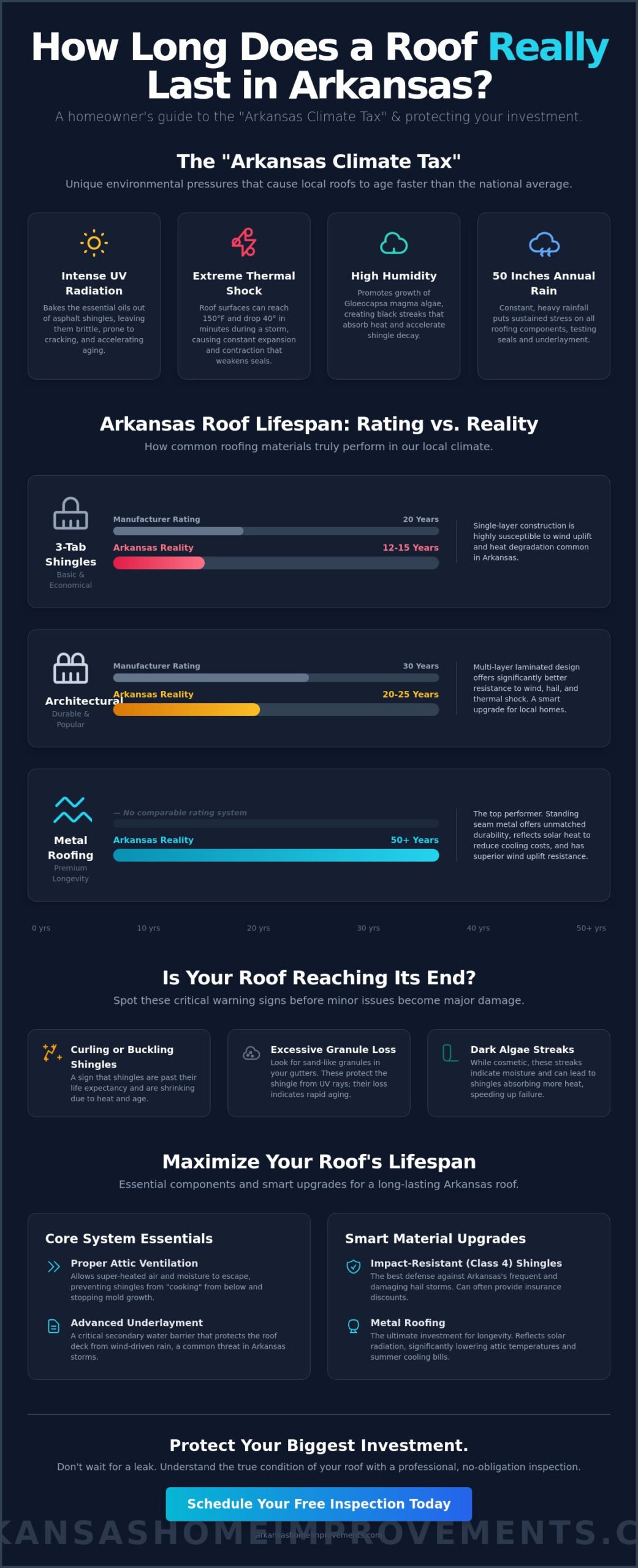
Understanding the lifespan of your roof starts with looking past the glossy manufacturer brochures. While a package might boast a 25 or 50-year warranty, those numbers are often tested in controlled environments rather than a central Arkansas July. When homeowners ask how long does a roof last in Arkansas, they’re looking for a realistic timeline that accounts for our state’s specific humidity and storm patterns. The gap between a manufacturer’s rating and the Arkansas reality is usually created by our 50 inches of annual rainfall and intense UV exposure. In the Natural State, we measure a roof’s life by its ability to withstand the elements, not just the calendar.
Asphalt Shingles: The 20-Year vs. 30-Year Reality
Asphalt shingles remain the most popular choice for local homes, but performance varies wildly between different styles. Standard 3-tab shingles consist of a single layer of material. They are an economical choice, but they often struggle with our intense summer heat. In contrast, architectural shingles use multiple layers of material laminated together. This extra thickness provides significantly better resistance to wind and hail. In our region, the Asphalt shingle lifespan is heavily influenced by thermal shock. This happens when a roof surface reaching 150 degrees is suddenly hit by a cold afternoon downpour. The rapid contraction and expansion cause shingles to become brittle, which eventually leads to cracks or loss of the protective granules that shield the asphalt from the sun.
- 3-Tab Shingles: Often rated for 20 years, but frequently require replacement after 12 to 15 years in Arkansas due to wind uplift and heat degradation.
- Architectural Shingles: Usually rated for 30 years; these typically provide 20 to 25 years of reliable service when properly ventilated.
The Rise of Metal Roofing in Central Arkansas
Metal roofing has seen a massive surge in popularity across cities like Benton and Cabot. Homeowners are increasingly choosing this material because it can easily exceed 50 years of service with minimal maintenance. Standing seam metal is the premium choice for residential properties. It uses hidden fasteners that are protected from the elements, unlike corrugated panels which have exposed screws that can leak over time. In high-wind corridors near Jacksonville and North Little Rock, the superior uplift resistance of metal provides significant peace of mind during storm season. Beyond durability, metal roofing reflects solar heat. During 100-degree heatwaves, this helps keep attic temperatures lower, which directly reduces the strain on your home’s cooling system. When considering how long does a roof last in Arkansas, metal is consistently the top performer for longevity and energy efficiency.
The Arkansas “Climate Tax”: Why Local Roofs Age Faster
While a roof in the Pacific Northwest might enjoy a long and stable life, homes in the Natural State face a unique set of environmental pressures. This phenomenon is often called the “Arkansas Climate Tax.” It represents the accelerated wear and tear that ultimately determines how long does a roof last in Arkansas. Our intense UV radiation acts like a slow-moving oven; it bakes the essential oils out of asphalt shingles. Over time, this loss of oil leaves the material brittle and prone to cracking under the slightest pressure.
Thermal expansion adds another layer of stress to the equation. In areas like Hot Springs and Malvern, the daily “stretch and shrink” cycle is particularly extreme. A roof surface can reach 150 degrees under the afternoon sun and then drop 40 degrees in minutes during a cooling thunderstorm. This constant movement strains the fasteners and shingle seals, slowly weakening the entire system. To combat these forces, homeowners should look for ways to Extend the Life of Your Roof through proactive maintenance and the selection of high-quality materials designed for the South.
Humidity and the “Black Streak” Problem
If you see dark, vertical streaks on your roof, you aren’t looking at dirt or soot. You’re likely seeing Gloeocapsa magma, a hardy type of blue-green algae that thrives in the heavy Arkansas humidity. While these streaks are primarily a cosmetic issue, they serve a functional warning. The dark color absorbs more heat, which further bakes your shingles and accelerates the aging process. The real danger comes from improper cleaning. Using a high-pressure washer to remove these streaks often blasts away the protective granules, doing more damage than the algae ever could. If you’re concerned about the appearance or health of your shingles, a professional Roofing Installation expert can provide a safe and thorough assessment.
Severe Storms and Granule Loss
Arkansas is famous for its volatile spring storm seasons. Even if a storm doesn’t produce “golf ball” sized hail, smaller stones and heavy rain still take a heavy toll. Each impact knocks away a small amount of the shingle’s ceramic granules. These granules are the “sunscreen” of your roof. Once they are gone, the underlying asphalt is exposed to direct sunlight, which causes the shingle to fail rapidly. Over several “minor” storm seasons, this cumulative loss significantly shortens the time between replacements. Checking your gutters for sand-like debris after a storm is a simple way to gauge this hidden aging process and stay ahead of potential leaks. If a significant storm has already struck your area, understanding the full scope of a hail damage roof replacement in Arkansas can help you navigate the insurance and restoration process before hidden damage worsens.
Maximizing Longevity: Installation Quality and Ventilation
The best roofing materials in the world can’t overcome a poor installation. While many people focus on shingle brand or color, the underlying system and the way it’s put together often determine how long does a roof last in Arkansas. A roof is more than just a waterproof lid; it’s a complex assembly that must manage heat, moisture, and wind pressure simultaneously. When even one component is overlooked, the entire structure’s lifespan can be cut in half. Achieving local longevity requires a combination of high-quality components and a deep understanding of our regional building codes.
Attic Ventilation in the Southern Heat
Poorly ventilated attics are silent killers for residential roofs. During our humid summers, a trapped attic space can easily reach 150 degrees. This extreme heat doesn’t just make your air conditioner work harder; it literally “cooks” your shingles from the underside. The relationship between high attic temperatures and shingle brittleness is direct; excessive heat accelerates the evaporation of protective oils, leading to premature cracking and seal failure. To prevent this, your home needs a balanced system of intake and exhaust.
- Intake Vents: Usually located at the soffits, these allow fresh, cooler air to enter the attic.
- Exhaust Vents: Located at the ridge or high on the roof, these allow hot, moist air to escape naturally.
- Airflow Balance: Without enough intake air, an exhaust vent can’t pull the heat out effectively, leaving your roof to bake in the sun.
Why Installation Craftsmanship Matters
Precision during the installation process is what separates a 15-year roof from a 25-year roof. One of the most common local failures we see is “high-nailing.” This happens when a technician places nails above the manufacturer’s designated nail line. When this occurs, the nail misses the top of the shingle below it, significantly reducing wind resistance. In a state prone to sudden, violent thunderstorms, these shingles are the first to blow off. Investing in professional roofing installation in Central Arkansas ensures that every fastener is placed exactly where it needs to be for maximum grip.
Beyond the shingles, the choice of underlayment is critical. We’ve moved beyond traditional felt paper to modern synthetic underlayments that offer better tear strength and moisture protection. In the valleys of your roof, where water concentrates, we use ice and water shields to provide a secondary layer of defense. These self-adhering membranes are essential for preventing leaks during the heavy downpours common in Benton and Little Rock. By following the 2018 International Residential Code (IRC) standards used across Arkansas, we ensure that every flashing point and sealant bead is designed to stand the test of time. This meticulous approach is the only way to truly maximize how long does a roof last in Arkansas; for readers seeking a broader look at technical standards for these systems, archersroofing.co.uk offers insights into professional pitched roofing.
Signs Your Arkansas Roof Is Reaching Its End
Identifying the right time for a replacement is often the difference between a controlled home improvement project and a stressful emergency. While we have discussed how the local climate impacts how long does a roof last in Arkansas, knowing how to spot physical deterioration can save you thousands in secondary water damage. Shingles don’t always fail all at once; they usually give off subtle warnings that their protective capabilities are fading. Being proactive allows you to plan for a new Roofing Installation on your own terms rather than during a rainy week in April.
Exterior Inspection Checklist
You don’t need to climb a ladder to perform a basic health check on your home. From the safety of the ground, look for “clawing” or “curling.” This occurs when the edges of the shingles turn upward or the middle starts to sink, indicating that the asphalt has lost its flexibility. After a typical Central Arkansas thunderstorm, check for shingles that appear lifted or out of alignment. Wind-lifted shingles often break the adhesive seal, allowing water to seep underneath during the next downpour. Pay close attention to the areas around your chimney. If the metal flashing is missing, rusted, or pulling away, it’s an urgent repair that shouldn’t wait for the next storm season.
The “gutter test” is another reliable indicator of age. If you find a handful of sand-like granules at the base of your downspouts, your roof is losing its UV protection. As we noted earlier, these granules are essential for shielding the asphalt from the sun. Once they wash away, the shingle becomes brittle and vulnerable to impact. Inside the home, head to the attic with a flashlight. If you see sagging roof decking between the rafters or pinpricks of daylight peeking through the boards, your roof has reached its limit.
The Insurance “Soft Cap” in Arkansas
One of the most overlooked factors in determining how long does a roof last in Arkansas is your insurance policy. Many local carriers are becoming stricter with older roofs, often implementing a “soft cap” at the 15-year mark. Once a roof passes this age, some insurers transition the coverage from “Replacement Cost Value” to “Actual Cash Value.” This means that if a storm hits, the payout is depreciated based on the roof’s age, leaving you to cover a much larger portion of the bill out of pocket.
Waiting for a visible leak to occur before seeking an inspection can be a costly mistake. If an adjuster determines that a leak was caused by long-term wear and tear rather than a specific storm event, they may deny the claim entirely. A professional assessment before the spring hail cycles begin ensures you understand your roof’s current condition and your insurance standing. Staying ahead of this 15-year milestone protects your financial interests and ensures your home remains a safe, dry sanctuary for your family. Homeowners who have recently experienced a storm should also review the full process of a hail damage roof replacement in Arkansas to understand how depreciation schedules and separate hail deductibles can affect what your insurer actually pays out.
Choosing the Right Roof for Your Arkansas Home’s Future
Selecting a new roof is a significant decision that impacts your home’s safety and value for decades. While we’ve explored the factors that dictate how long does a roof last in Arkansas, the final step is matching a specific material to your property’s unique surroundings. A house nestled under a heavy tree canopy faces different challenges than a home in a sun-drenched new development in Benton. Selecting the right shingle or metal panel today prevents the climate from taking an early toll on your investment. By considering your lot’s specific exposure, you can choose a system that stays durable and beautiful for its entire intended lifespan.
In our hail-prone region, Class 4 impact-resistant shingles are often the smartest upgrade for long-term peace of mind. These shingles are engineered to withstand the force of larger hailstones without cracking the underlying asphalt mat. While the initial investment is higher than standard options, the long-term savings in avoided repairs and potential insurance discounts make them a high-value choice for many local families. When you combine high-quality materials with the precision installation techniques we’ve discussed, you ensure your home remains a safe, dry sanctuary regardless of the weather.
Is an Upgrade Worth It?
Architectural shingles offer a much higher return on investment compared to standard 3-tab options. They provide superior wind resistance and a more dimensional look that immediately boosts curb appeal. In cities like Cabot and Jacksonville, homeowners are increasingly turning to metal roofing to combat the rising costs of summer cooling. Metal reflects solar energy, which helps keep your home more comfortable during our humid heatwaves. For complete storm-season readiness, many residents also prioritize reliable backup power with home generators to ensure their family remains safe if the grid goes down during a severe weather event.
Your Local Roofing Partner
At Arkansas Home Improvement, we believe in local accountability and a “job well done” mentality. Steve and our entire team take immense pride in every project, from the initial inspection to the final cleanup. We don’t just perform a service; we build long-term relationships based on consistency and professional standards. Our service area extends from Arkadelphia to Hot Springs Village, ensuring that homeowners across Central Arkansas have access to seasoned craftsmanship and dependable advice.
We understand that a roof replacement is a major project, and our goal is to reduce your stress through clear communication and honest assessments. We stand behind our work and prioritize warranty fulfillment, so you always know who to call if you have questions. Before committing to any contractor, it’s worth reviewing how to choose a roofing contractor Arkansas homeowners can trust, including how to verify state registration and avoid storm chasers, as outlined in our 2026 Arkansas roofing contractor selection guide. If you’re wondering exactly how long does a roof last in Arkansas for your specific property, the best way to find out is through an expert evaluation. Contact Arkansas Home Improvement today for a comprehensive roof health check to ensure your home is ready for the years ahead.
Secure Your Home’s Future with Confidence
Protecting your home against the unique challenges of the Natural State climate requires a proactive approach. As we’ve explored, the answer to how long does a roof last in Arkansas depends on more than just the material you choose. It involves understanding the local climate tax, ensuring your attic has the breathability to handle 100 degree heatwaves, and staying ahead of the critical 15 year insurance milestone. By focusing on quality installation and timely inspections, you can turn a potential emergency into a well managed home improvement project that adds lasting value.
Arkansas Home Improvement brings over 15 years of local service to every project in Central Arkansas. Our team offers specialized expertise in both durable metal roofing and high performance asphalt shingle systems. We take immense pride in our A+ reputation for customer satisfaction and reliable warranty fulfillment. Don’t wait for a leak to reveal hidden damage or compromise your insurance coverage. Get Your Professional Arkansas Roof Inspection Today and gain the peace of mind that comes from a job well done. Your home is your most valuable investment, and we’re here to help you protect it for the long term.
Frequently Asked Questions
How long does a typical 30-year shingle roof actually last in Arkansas?
In our climate, a 30-year architectural shingle roof usually provides 20 to 25 years of reliable service. While the manufacturer’s rating is based on ideal conditions, the “Arkansas Climate Tax” of high humidity and 90-degree summer highs causes asphalt to degrade faster. Proper attic ventilation is the most critical factor in helping these shingles reach the upper end of that range.
Does Arkansas heat shorten the life of a metal roof?
No, heat doesn’t typically shorten the lifespan of a metal roof. In fact, metal roofing is designed to reflect solar radiation, which helps protect the material’s structural integrity during 100-degree heatwaves. While extreme UV exposure can eventually impact the paint finish, the underlying metal remains durable for 40 to 70 years in central Arkansas.
What is the best roofing material for high-wind areas in Central Arkansas?
Standing seam metal roofing and Class 4 impact-resistant shingles are the best choices for high-wind corridors near Jacksonville and North Little Rock. These systems feature superior fastening patterns that prevent shingle uplift during violent spring storms. Pairing these materials with a high-quality synthetic underlayment provides the best defense against the heavy rain and wind common in our region.
Will my insurance pay for a 20-year-old roof replacement in Arkansas?
It’s often difficult to get full coverage for a roof of that age. Many local insurers implement a “soft cap” at the 15-year mark, transitioning policies to Actual Cash Value (ACV). This means the payout is depreciated based on age. If an adjuster determines that damage is due to wear and tear rather than a specific storm, they may deny the claim entirely.
How often should I have my roof inspected in Little Rock or Benton?
You should have a professional assessment at least once every two years. In cities like Little Rock or Benton, it’s also wise to schedule an inspection after any significant hail event. Regular checks allow you to identify minor issues like cracked flashing or granule loss before they lead to expensive interior water damage.
Can I install a new roof over my old one to save money?
We don’t recommend this practice because it significantly reduces how long does a roof last in Arkansas. A second layer of shingles traps heat, which bakes the new material from both sides and leads to premature brittleness. Additionally, a “lay-over” prevents us from inspecting the wooden decking for rot or structural weaknesses that must be repaired for a safe installation.
Does attic ventilation really impact how long my shingles last?
Yes, ventilation is the number one predictor of shingle health in the South. Without balanced airflow, attic temperatures can soar to 150 degrees, which cooks the asphalt and destroys the adhesive seals. A well-ventilated system ensures that heat and moisture escape, preventing the shingles from becoming brittle and failing years before their time.
What are the signs of hail damage that I can see from the ground?
Look for dark, circular “bruises” on the shingle surface or excessive sand-like granules in your gutters and downspouts. You can also check for dents in soft metal components like roof vents, gutters, or even your mailbox. If you see these signs after a storm, it’s a strong indicator that the protective surface of your roof has been compromised.