
Imagine it’s a humid Tuesday night in Hot Springs Village and the sky turns that familiar shade of bruised purple just before the grid fails. You aren’t just worried about the lights; you’re thinking about the thick air quickly turning your home into a sauna and whether your expensive electronics will survive the surge. Many homeowners turn to a whole home generator sizing calculator Arkansas to find a quick answer, but a generic online tool often fails to account for the massive load your A/C carries during a Southern heatwave. You need the confidence that comes from a system sized for local reality, not just a national average.
We’ll help you master the math of backup power so you can find the perfect generator size to keep your family cool and safe through any storm. This guide breaks down the confusion between surge and running watts while explaining how Arkansas humidity increases your specific power requirements. You will learn how to reach a clear kW estimate for your home and understand the professional installation process in Hot Springs. We’ll ensure you have the facts to make a decision that provides long-term stability and protection for your property.
Key Takeaways
- Learn why the unique climate of Hot Springs and Hot Springs Village demands a tailored power calculation to prevent system failure during peak summer heat.
- Discover how to accurately input your appliance data into a whole home generator sizing calculator Arkansas by accounting for the “kickstart” power needed for your A/C.
- Choose between “Essential Load” and “Full Comfort” strategies to ensure your family stays safe and cool without overspending on unnecessary capacity.
- Follow our simple worksheet to calculate your total kilowatt needs and identify the critical loads that protect your home’s most expensive electronics.
- Gain peace of mind by understanding the local permitting and HOA requirements specific to the Hot Springs region before you begin your installation.
Why Accurate Generator Sizing is Critical for Arkansas Homes
Getting the math wrong on your backup power system can lead to more than just a tripped breaker. In the middle of an Arkansas summer heatwave, an undersized unit might shut down exactly when your A/C is working hardest to combat the humidity. While a What is a Standby Generator? search provides the basics, local residents know that our specific climate adds unique stress to these systems. Using a whole home generator sizing calculator Arkansas is a great starting point, but it’s only the first step in ensuring your home remains a sanctuary during a blackout. Professional sizing accounts for the real world, not just a spreadsheet.
In Hot Springs Village, residents often prioritize whole home reliability because of the distance from major utility hubs and the potential for longer response times. If your generator is too small, it can cause “brownout” conditions that damage sensitive circuit boards in your refrigerator, computer, or home theater system. Conversely, falling into the “oversizing trap” means you’ll pay for fuel you don’t actually need, which adds up quickly during a multi-day outage. You want a unit that works efficiently without straining its engine or wasting your resources.
The Impact of Central Arkansas Storm Patterns
Storms in the Ouachita Mountains aren’t always brief. Tornado season and severe thunderstorms can knock out power for days at a time, making localized reliability a top concern for homeowners in Hot Springs. During these events, your generator must handle more than just a few lights. It needs the capacity to keep sump pumps active to prevent basement flooding and keep your HVAC system running to mitigate mold growth. For those in rural parts of the state, your sizing must also account for how long your fuel supply will last under heavy loads. A whole home generator sizing calculator Arkansas helps you visualize these needs before the next storm cloud appears on the horizon.
Cost vs. Capacity: Finding the Sweet Spot
Finding the right balance involves looking at both the upfront price and the long-term health of the machine. A unit that constantly runs at 100% capacity will experience premature engine wear and frequent mechanical failures. By sizing the unit correctly, you ensure it operates at an efficient “cruising” speed that extends its lifespan. The sweet spot of sizing is the intersection of essential needs and budget. This approach protects your investment while guaranteeing that your family stays comfortable regardless of the weather outside. We take pride in helping you find that balance, ensuring your installation provides peace of mind for years to come.
The Math of Power: How a Generator Sizing Calculator Works
To get an accurate Generator Sizing Calculation, you must first speak the language of power: the Kilowatt (kW). One kW equals 1,000 watts. While it’s tempting to find a unit that matches your peak usage exactly, professional standards dictate a 20% safety margin. You wouldn’t drive your car at its maximum RPM for hours; your generator shouldn’t “redline” either. This buffer protects the internal components and ensures your home in Hot Springs Village stays powered without the risk of a system crash during a storm.
Your home’s electrical panel also plays a major role in this equation. Most modern homes in Hot Springs feature a 200-amp service, which influences how much power the generator can safely distribute through your transfer switch. If you’re curious about how your specific panel might affect your setup, you can consult with our team to verify your home’s capacity before making a purchase. Understanding these technical limits is what separates a reliable installation from a frustrating one.
Understanding Starting Watts (Surge Demand)
The biggest hurdle for any standby unit is the initial “kick” required to start large motors. This is often referred to as surge demand or “Locked Rotor Amps” (LRA). In our region, the main culprits are HVAC compressors and well pumps. Arkansas humidity makes your A/C work harder, meaning its surge demand is often higher than national averages. We often recommend modern soft-start kits for residents in Hot Springs. These kits reduce the initial power spike, which can sometimes allow you to choose a slightly smaller, more fuel-efficient generator without sacrificing performance.
Calculating Continuous Running Load
Once your appliances are running, you need to account for the continuous load. This includes “must-have” items like medical equipment, refrigeration, and lighting. While square footage provides a rough starting point, it doesn’t tell the whole story. A 2,500-square-foot home in Hot Springs Village with energy-efficient LED bulbs has a different profile than a similar home with older lighting. You must also consider the cumulative effect of small electronics. Laptops, Wi-Fi routers, and charging stations don’t draw much power individually, but together they create a steady drain that a whole home generator sizing calculator Arkansas must account for to ensure total reliability.
Essential Loads vs. Full Comfort: Sizing for the Arkansas Summer
Choosing between essential backup and full comfort is the most personal step in the process. While a generic whole home generator sizing calculator Arkansas might give you a raw number, it doesn’t know if you’re willing to skip the laundry during a blackout or if you need every room in your Hot Springs Village home at 72 degrees. The decision usually comes down to how you handle the brutal Arkansas summer. If you have all-electric appliances, your power demand will be significantly higher than a home with gas heating and cooking, as electric ranges and water heaters are massive “kW hogs” that can quickly overwhelm a smaller unit.
We find that many homeowners in Hot Springs start by listing their absolute necessities, then realize that “comfort” in 90% humidity is actually a necessity. Sizing for a full-comfort lifestyle ensures that your family stays safe and your property remains protected from the moisture damage that can occur when climate control is lost for several days. It’s about maintaining your quality of life regardless of what the grid is doing.
The Arkansas Summer Factor: A/C and Humidity
Arkansas humidity is the invisible weight on your generator. When temperatures in Hot Springs hit 100 degrees, your air conditioner doesn’t just run; it struggles. This environment forces the compressor to work at peak capacity for longer cycles. For every ton of cooling, you typically need about 3.5 kW of generator capacity just to keep it running, but the startup surge is what usually trips the system. We’ve observed that homes with high-performance window replacements often require smaller generators because their homes retain cool air longer, reducing the frequency of those power-hungry A/C start cycles.
Prioritizing Your Power Needs
To help you decide, we categorize power needs into three distinct tiers based on typical Central Arkansas usage patterns:
- Essential Load Tier (10-14kW): Focuses on survival. It covers well pumps, the refrigerator, a few lights, and a single window unit or a small central A/C zone.
- Managed Whole Home Tier (14-20kW): This is the most popular choice in Central Arkansas. It uses smart load shedding to prioritize the A/C while temporarily pausing the water heater or dryer if demand spikes.
- Full Comfort Tier (22kW+): This is for the homeowner who wants no lifestyle changes. It powers multiple A/C units, pool pumps, and every electric appliance simultaneously.
By identifying which tier fits your family’s needs, you can use a whole home generator sizing calculator Arkansas with much more precision. This ensures you don’t pay for capacity you’ll never use or, worse, end up with a unit that can’t handle a July afternoon in the Ouachita Mountains.
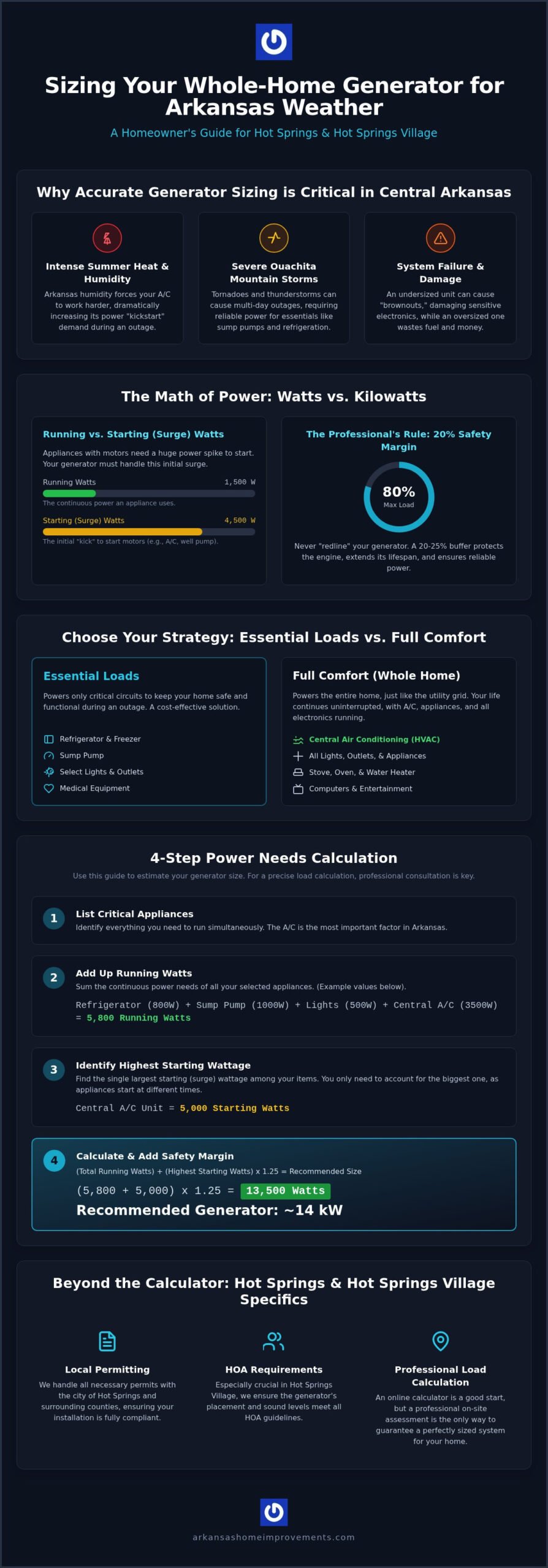
Step-by-Step Worksheet: Estimating Your Generator Size
While an online whole home generator sizing calculator Arkansas is a helpful tool, performing a manual check gives you a deeper understanding of your home’s specific needs. This process removes the guesswork and helps you visualize how your power will be distributed during an outage. Follow these four steps to build a reliable estimate for your Hot Springs property.
- Step 1: Identify your “Critical Load” appliances and record their running watts. These are the items that must stay on continuously, such as your refrigerator, medical devices, and home security system.
- Step 2: Find the single highest starting wattage requirement. In most Central Arkansas homes, this is the central air conditioning unit. You only need to account for the single largest “surge” because it’s unlikely all your large motors will attempt to start at the exact same second.
- Step 3: Add your total running watts from Step 1 to the highest surge requirement found in Step 2.
- Step 4: Apply the Arkansas 20% weather-buffer. This extra capacity ensures your generator can handle the increased workload caused by our peak summer temperatures and high humidity without straining the engine.
Common Appliance Wattage Estimates for Arkansas Homes
To help you fill out your worksheet, we’ve gathered typical wattage requirements for common equipment found in the Hot Springs region. Use these figures as a baseline for your whole home generator sizing calculator Arkansas inputs:
- Central A/C (3-ton): 4,000 running watts / 12,000 starting watts
- Well Pump (1/2 HP): 1,000 running watts / 2,100 starting watts
- Electric Water Heater: 4,500 running watts / 4,500 starting watts
- Refrigerator/Freezer: 700 running watts / 2,200 starting watts
Refining Your Estimate with Load Management
If you live in a larger home in Hot Springs Village with multiple HVAC units, you don’t necessarily need a massive, industrial-sized generator. Modern “Smart Switches” can manage your power by prioritizing specific loads. For example, the system can briefly pause power to your water heater to ensure the A/C has enough “kick” to start its compressor. This managed approach allows you to enjoy whole-home comfort with a more efficient kW rating. It’s a strategic way to keep your installation costs down while maintaining a high level of reliability. A calculator provides an estimate, but a site survey provides a guarantee. To ensure your system is perfectly matched to your home’s electrical layout, schedule a professional sizing consultation with our experienced team.
Professional Installation: Beyond the Calculator with Arkansas Home Improvement
While a whole home generator sizing calculator Arkansas provides a useful starting point, it cannot account for the physical constraints of your property or the specific electrical code requirements in your municipality. DIY sizing often leads to expensive mistakes, such as choosing a unit that doesn’t meet the fuel pressure requirements of your existing gas line. These errors can void your manufacturer’s warranty and leave you without protection when a storm hits. Professional installation ensures that every component, from the concrete pad to the wiring, meets the highest standards of safety and reliability.
Our team understands the unique challenges of installing backup power in Hot Springs and Hot Springs Village. We navigate the complex HOA regulations and utility rules that often catch homeowners by surprise. We also look at the big picture of your home’s health. We ensure your generator placement doesn’t interfere with your home’s siding or roofing drainage, protecting your exterior while securing your interior power. Central to this setup is the Automatic Transfer Switch (ATS). This device monitors the grid and triggers a seamless transition to backup power within seconds of an outage, ensuring your home stays online without you ever having to flip a switch.
The Site Survey: The Gold Standard of Sizing
A professional site survey is the only way to guarantee your system will perform as expected. During this visit, we evaluate your natural gas or propane supply to ensure it meets 2026 standards for pressure and volume. We also determine the safest placement for the unit, focusing on noise reduction for your neighbors and proper exhaust clearance to keep your family safe. This level of detail is something a digital tool simply cannot provide. Learn more about our home generator installation Arkansas services to see how we handle every technical detail for you.
Service Areas and Local Commitment
We take pride in serving our neighbors across Central Arkansas. Our technicians provide dedicated support for residents in Arkadelphia, Benton, Cabot, and Little Rock. However, we place a special emphasis on the unique backup needs of Hot Springs Village. The terrain and utility layout in the Village require a seasoned expert who knows how to manage specific lot constraints and permitting hurdles. We’ve spent over 15 years building a reputation for consistency and craftsmanship throughout the region. Schedule your professional generator sizing survey today to secure your home’s future and gain the peace of mind you deserve.
Secure Your Peace of Mind with Reliable Backup Power
Preparing your home for the unpredictable Arkansas climate requires more than a simple guess. While a whole home generator sizing calculator Arkansas provides an excellent baseline, the final decision should account for the specific humidity levels of Hot Springs and the unique electrical requirements of your property. By balancing your essential needs with the right safety margin, you ensure that your A/C keeps humming and your food stays fresh even during multi-day outages.
Arkansas Home Improvement has served Central Arkansas for over 15 years. We’ve built our reputation on being local experts who understand the specific utility and HOA requirements of Hot Springs Village. Our team brings comprehensive expertise in both interior and exterior systems to every project, ensuring your generator installation is as seamless as the power transition it provides. Don’t leave your family’s safety to chance when the next storm rolls in. Request a Professional Generator Sizing Consultation today and take the first step toward total home protection. We’re here to help you make a choice that brings lasting comfort and stability to your home.
Frequently Asked Questions
What size generator do I need for a 2,000 sq. ft. home in Arkansas?
Most 2,000 sq. ft. homes in Hot Springs require a 14kW to 20kW unit depending on your cooling needs. A whole home generator sizing calculator Arkansas can help you determine if you only need the essentials or a full comfort setup. We typically see homeowners in this square footage range opt for a 20kW unit to ensure their central air conditioning runs smoothly alongside refrigerators and lighting during severe weather.
Can a 22kW generator run my whole house including the A/C?
Yes, a 22kW generator is usually sufficient to power a standard home including a 5-ton central A/C unit. It’s the most common choice for families in Hot Springs Village who want to maintain their lifestyle without making sacrifices during an outage. This capacity handles high-draw appliances like electric water heaters and well pumps while providing enough overhead to prevent the system from overloading during peak summer heat.
How much extra power should I budget for an Arkansas summer heatwave?
You should budget approximately 20% more power than your standard running watts to account for extreme heat and humidity. High temperatures force your A/C compressor to run longer cycles and work harder to remove moisture from the air. This environmental stress increases the load on your generator’s engine. Adding this buffer ensures your system doesn’t trip when the outdoor thermometer hits triple digits in Central Arkansas.
Is it better to have a slightly oversized or undersized generator?
It’s always better to have a slightly oversized generator to protect your home’s expensive electronics and the unit’s engine. An undersized unit will struggle to meet demand, leading to power fluctuations that can damage circuit boards in your appliances. A slightly larger unit runs more efficiently at a lower RPM, which extends its lifespan and provides the peace of mind that it won’t fail when you need it most.
Do I need a different size generator if I use propane instead of natural gas?
No, the physical size of the generator remains the same, but you must check the specific kW rating for each fuel type. Generators often produce slightly more power when running on liquid propane compared to natural gas. When you use a whole home generator sizing calculator Arkansas, ensure you select your intended fuel source to see the most accurate output rating for your specific installation in Hot Springs or surrounding areas.
Will a whole home generator increase my Arkansas property value?
Yes, a professionally installed standby generator is a highly desirable feature that can increase your home’s resale appeal and overall value. In markets like Hot Springs Village, where residents prioritize reliability and safety, having a permanent backup power solution is a significant selling point. It signals to potential buyers that the home is well-maintained and prepared for the severe weather common to Central Arkansas.
How do I calculate the starting watts for my older HVAC unit?
You can find the starting requirements by checking the “Locked Rotor Amps” (LRA) listed on your A/C unit’s data plate. Multiply the LRA by the voltage, which is usually 240V, to find the surge wattage. Older units often have higher starting requirements than modern models. We recommend having a professional verify these numbers since an accurate calculation is vital to prevent your generator from stalling during the initial startup surge.
What is the most common generator size for homes in Hot Springs Village?
The 22kW unit is the most popular choice for residents in Hot Springs Village due to the prevalence of all-electric homes and larger floor plans. This size provides enough capacity to run multiple HVAC zones, well pumps, and kitchen appliances simultaneously. It offers the reliability needed for the specific terrain and utility constraints of the Village, ensuring your home remains fully functional through any grid interruption.