
Your home’s siding does more than just look good — it’s the first line of defense against Arkansas’s unpredictable weather, and when it starts to fail, the consequences go far beyond curb appeal. If you’ve been putting off home siding replacement in Benton, AR, you’re not alone. Many homeowners feel overwhelmed by the choices, the costs, and the challenge of finding a contractor they can actually trust.
That uncertainty is completely understandable. With so many siding materials on the market and no shortage of opinions online, it’s hard to know where to start or who to believe. You want a solution that looks great, holds up to the elements, and doesn’t require constant upkeep — and you want it installed by someone who knows what they’re doing.
This guide is here to make that decision easier. You’ll learn about the most popular siding materials available to Benton homeowners, what to expect from the installation process, and how to identify a reliable local contractor. By the end, you’ll have the confidence to move forward with a project that protects and transforms your home for years to come.
Key Takeaways
- Siding replacement is about more than aesthetics — understanding the warning signs of failing siding can help you act before minor issues become costly structural damage.
- Choosing the right material for home siding replacement in Benton, AR means weighing durability, maintenance requirements, and upfront costs against long-term value for your specific home.
- The installation process follows a clear, manageable sequence — knowing what to expect at each stage helps you stay informed and avoid unwelcome surprises.
- Hiring the right contractor makes or breaks a siding project, and a few targeted questions during the selection process can reveal everything you need to know about a company’s reliability.
- New siding delivers measurable returns, from improved energy efficiency to increased resale value — making it one of the smartest investments a homeowner can make.
What is Home Siding Replacement?
Home siding replacement is the process of removing your existing exterior cladding and installing new material in its place. It’s a full exterior renovation, not a patch job. Unlike spot repairs that address isolated damage, replacement gives your home a complete reset, restoring structural protection, improving energy performance, and refreshing the appearance from the ground up.
For Benton homeowners, this is a particularly meaningful investment. Arkansas weather is demanding. Hot, humid summers, sudden storms, and temperature swings that shift dramatically between seasons put constant stress on exterior surfaces. Siding that was adequate a decade ago may no longer be doing its job effectively today.
When homeowners begin exploring home siding replacement in Benton, AR, they’re usually motivated by one or more of the following:
- Visible deterioration that repairs can no longer fix
- Rising energy bills that suggest the home’s thermal envelope has been compromised
- Planning a sale and wanting to maximize resale value
- Aging materials that have simply reached the end of their useful life
- Persistent moisture issues like mold, rot, or water intrusion behind the walls
Importance of Choosing the Right Siding
Siding does more than define how your home looks from the street. It acts as a thermal barrier, reducing heat transfer between your living space and the outdoors. Poorly performing siding forces your HVAC system to work harder, which shows up directly on your utility bills. New siding, particularly insulated options, can meaningfully reduce that load. Beyond efficiency, the right material choice affects how often you’ll need to repaint, repair, or replace it again down the road. Some materials require almost no upkeep; others demand regular attention. Knowing the difference before you commit saves you time and money for years to come.
Common Signs Your Siding Needs Replacement
Siding rarely fails all at once. It sends signals first. Warping, cracking, or buckling panels are obvious indicators, but subtler signs matter just as much. If you’re noticing soft spots near windows or doors, that often points to moisture that’s already worked its way behind the surface. Mold or mildew streaking that returns shortly after cleaning is another red flag. And if your home feels drafty in winter or stuffy in summer despite a working HVAC system, deteriorating siding may be the cause.
Age alone is worth considering. Many siding materials carry a functional lifespan, and once a product approaches or exceeds that window, proactive replacement is smarter than waiting for a failure that damages the structure beneath.
Understanding what home siding replacement in Benton, AR actually involves is the foundation for making a confident, well-informed decision. The sections that follow will walk you through your material options, the installation process, and how to choose a contractor you can trust.
Comparing Siding Materials: Which is Right for Your Home?
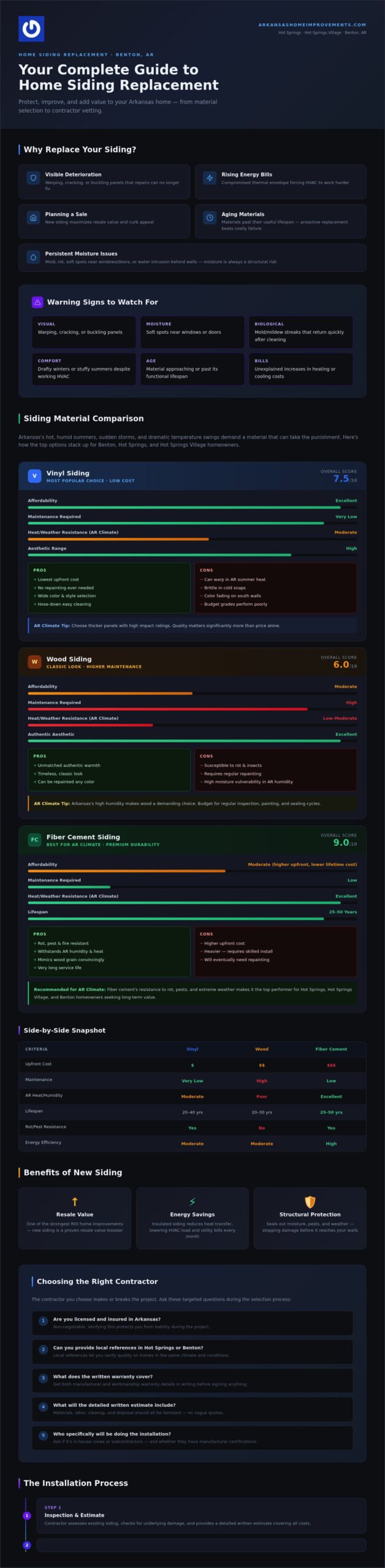
Choosing the right siding material is one of the most consequential decisions in any home siding replacement Benton AR project. The material you select determines how your home looks, how well it holds up to Arkansas’s demanding climate, and how much time and money you’ll spend on upkeep over the next decade or two. There’s no single “best” option — the right choice depends on your priorities, your home’s architectural style, and your budget.
Here’s a clear-eyed look at the three materials Benton homeowners most commonly consider.
Vinyl Siding: Pros and Cons
Vinyl is the most widely installed siding material in the country, and for good reason. It’s cost-effective, requires almost no maintenance, and comes in a broad range of colors, textures, and profiles — from traditional lap siding to board-and-batten styles. You won’t need to repaint it, and cleaning is typically as simple as a garden hose and mild detergent.
That said, vinyl has real limitations. Lower-grade products can warp in extreme heat or become brittle in cold snaps — both of which Arkansas delivers. Color fading is a legitimate concern over time, particularly on south-facing walls that absorb direct sun for hours each day. If you go with vinyl, product quality matters significantly. Thicker panels with higher impact ratings perform considerably better in harsh conditions than budget-grade alternatives.
Wood Siding: A Classic Option
Wood siding has an authentic warmth that manufactured materials genuinely struggle to replicate. Cedar and redwood are popular choices for their natural resistance to moisture and insects, and wood’s insulating properties add real thermal value. It’s particularly well-suited to craftsman bungalows, farmhouses, and traditional architectural styles where that organic texture is part of the home’s character.
The trade-off is maintenance. Wood requires periodic painting or staining, and in Arkansas’s humid climate, that schedule needs to be kept consistently. Neglect opens the door to rot, mold, and insect damage. For homeowners willing to commit to that upkeep, wood delivers unmatched beauty. For those who aren’t, it’s a costly obligation.
Fiber Cement: Durability Meets Aesthetics
Fiber cement has become the go-to material for homeowners who want the look of wood without the maintenance burden. It resists rot, pests, and fire, and it holds paint exceptionally well — meaning color stays truer for longer. The upfront cost is higher than vinyl, but the long-term savings on repainting, repairs, and potential replacement often make it the smarter financial decision over a 20-plus-year horizon.
It’s also one of the most versatile options aesthetically, available in profiles that convincingly mimic wood grain, shingles, or smooth finishes. For Benton homeowners navigating the full scope of a home siding replacement in Benton, AR, fiber cement consistently earns high marks across durability, appearance, and long-term value.
- Vinyl: Best for budget-conscious homeowners who want low maintenance and broad color selection
- Wood: Best for specific architectural styles where authentic texture is a priority and maintenance is manageable
- Fiber cement: Best for homeowners prioritizing long-term durability, fire resistance, and minimal upkeep
Still weighing your options? Talk to a local siding specialist who can assess your home’s specific needs and help you choose the material that makes the most sense for your situation.
The Siding Replacement Process: What to Expect
Knowing what happens at each stage of a home siding replacement Benton AR project takes the guesswork out of a process that can otherwise feel overwhelming. From the first conversation with a contractor to the final walkthrough, the sequence is logical and manageable. Here’s what the process actually looks like.
It starts with a thorough assessment of your home’s current condition. A qualified contractor will inspect the existing siding, check for moisture damage or rot beneath the surface, and evaluate the condition of the underlying sheathing and house wrap. This step matters because what’s discovered beneath the old siding can influence both the material recommendations and the project timeline. Once the assessment is complete, you’ll work through material selection, color choices, and scheduling before any physical work begins.
Timeline varies by home size and material, but most residential siding replacements are completed within a few days to a week. Fiber cement installations tend to take slightly longer than vinyl due to the cutting and finishing requirements of the material. Weather is a factor too. Arkansas summers can create scheduling windows that shift, so building in some flexibility is wise.
Preparation for Siding Replacement
Installation day runs more smoothly when your home is ready for the crew. Clear a three-to-five foot perimeter around your home’s exterior by moving patio furniture, potted plants, grills, and any decorative items. Trim back shrubs or low-hanging branches that could restrict access to the walls. Inside, take down any wall art or shelving near exterior walls, since vibration from removal and installation can shake items loose.
Expect noise. Siding removal and installation involve power tools, nail guns, and general construction activity throughout the day. If you have pets or young children, arranging for them to be elsewhere during peak work hours is worth considering. A reputable contractor will keep the work area organized and protect landscaping where possible, but some disruption is part of the process.
Post-Installation: Maintenance and Care
New siding is built to last, but a little routine attention extends that lifespan considerably. Plan to rinse your siding once or twice a year with a garden hose to clear dirt, pollen, and debris. Inspect caulking around windows, doors, and trim annually, and reseal any areas that show cracking or separation before moisture finds a way in.
Watch for these signs that warrant a closer look:
- Soft or spongy panels near ground level, which can indicate moisture intrusion
- Gaps or separation at seams or corners where panels meet
- Staining or discoloration that returns after cleaning, suggesting mold or mildew activity
- Visible impact damage after severe storms, particularly hail events
Scheduling a professional inspection every few years, or promptly after a major storm, keeps small issues from developing into larger structural problems. The investment you’ve made in quality siding deserves that level of care, and staying proactive is always less expensive than reactive repairs.
Choosing the Right Contractor for Siding Replacement
The material you choose matters. The installation matters more. Even the best fiber cement or premium vinyl will underperform if it’s installed by someone cutting corners on technique, moisture barriers, or flashing. For any home siding replacement Benton AR project, the contractor you hire is the single most consequential decision you’ll make.
The challenge is that most homeowners don’t hire siding contractors regularly, so there’s no built-in instinct for separating the reliable from the unreliable. The good news: a few targeted questions and some basic due diligence will tell you almost everything you need to know before signing anything.
Questions to Ask Potential Contractors
Go into any initial conversation with a prepared list. Vague answers to direct questions are a signal worth paying attention to.
- “How many siding installations have you completed in the past two years?” Experience with your specific material matters. A contractor who primarily installs vinyl may not be the right fit for a fiber cement project.
- “Can you provide references from clients whose projects are at least two years old?” Recent references are useful, but older ones reveal how the work holds up over time and whether the company stands behind it.
- “What warranties do you offer on both materials and labor?” Material warranties come from the manufacturer, but labor warranties come from the contractor. Both matter. A company that won’t back its own workmanship is telling you something important.
- “Who will actually be on the job site?” Some contractors subcontract the physical installation. Know who’s doing the work before you agree to anything.
- “How do you handle unexpected issues, like moisture damage or rot found during removal?” How a contractor answers this question reveals their transparency and their process.
Verifying Credentials and Reviews
Arkansas requires contractors to be licensed for work above certain thresholds. Before hiring anyone, confirm they hold a current license and carry both general liability insurance and workers’ compensation coverage. Ask for certificates directly. A reputable contractor will provide them without hesitation.
Online reviews are worth reading, but read them critically. Look for patterns rather than outliers. A company with dozens of reviews mentioning punctuality, clean job sites, and responsive communication is more telling than a single glowing testimonial. Pay equal attention to how a company responds to negative reviews; professionalism under criticism says a lot about how they handle problems on the job.
Don’t skip the contract review. A solid agreement should specify the scope of work, the materials being used (including product grade and manufacturer), the payment schedule, the projected timeline, and the warranty terms in writing. Verbal assurances don’t protect you. If something was promised in conversation, it belongs in the contract.
Choosing well at this stage protects everything that comes after. Connect with Arkansas Home Improvement to work with a local team that brings verified experience and a genuine commitment to getting the job done right.
Benefits of New Siding: Why Invest in Your Home?
New siding isn’t just a cosmetic upgrade. It’s a structural investment that pays dividends in energy savings, weather protection, comfort, and resale value. For homeowners weighing the full picture of home siding replacement Benton AR, understanding the long-term returns makes the decision considerably easier.
Arkansas’s climate is relentless. Humidity, heat, and storm activity don’t give aging siding much of a break, and the cumulative toll shows up in ways that affect your home from the inside out. Fresh, properly installed siding reverses that damage and puts your home back on solid footing.
Long-Term Savings on Energy Bills
Deteriorating siding creates gaps in your home’s thermal envelope. Conditioned air escapes; outdoor air infiltrates. Your HVAC system compensates by running longer cycles, and your utility bills reflect that extra load month after month.
Quality replacement siding addresses this directly. Insulated vinyl, for example, incorporates a foam backing that reduces thermal bridging through the wall studs. Fiber cement, while not inherently insulated, pairs well with continuous exterior insulation installed during replacement. Either way, the result is a tighter building envelope that holds temperature more consistently.
The savings aren’t abstract. Reduced air infiltration means your heating and cooling equipment doesn’t work as hard, which extends its lifespan alongside lowering your bills. That’s a compounding benefit that grows over time.
Impact on Home Resale Value
Remodeling Magazine’s annual Cost vs. Value report consistently ranks siding replacement among the highest-returning exterior renovation projects nationwide. Fiber cement siding replacement, in particular, has historically recouped a strong percentage of its cost at resale. Buyers notice the exterior first, and new siding signals that the home has been well maintained, which builds confidence before they ever step inside.
In the Benton market, where buyers have options and first impressions carry real weight, updated siding can meaningfully shorten time on market. A home that looks well cared for from the curb invites more serious interest from the start.
Beyond resale, there are daily quality-of-life returns that don’t show up in any financial report. Rooms feel more comfortable. Drafts disappear. The persistent hum of a struggling HVAC system quiets down. And the exterior your neighbors and guests see reflects the care you’ve put into your home.
New siding also eliminates a category of ongoing worry. Pest intrusion, moisture behind the walls, and rot spreading through the sheathing are real risks with failing cladding. Replacement closes those vulnerabilities completely.
- Energy performance: A tighter thermal envelope reduces heating and cooling demand year-round
- Resale value: New siding consistently delivers strong returns at the point of sale
- Weather and pest protection: Properly installed siding eliminates entry points for moisture and insects
- Daily comfort: Consistent indoor temperatures and reduced drafts improve livability immediately
- Reduced maintenance burden: Modern materials require far less ongoing attention than older alternatives
Every benefit compounds the one before it. That’s what makes home siding replacement in Benton, AR one of the smartest home improvement decisions you can make. Ready to see what it looks like for your home? Connect with Arkansas Home Improvement and get started with a team that knows how to deliver results built to last.
Your Home Deserves a Fresh Start — Take the Next Step Today
Replacing your siding is one of those decisions that rewards you on multiple fronts at once. You get a stronger thermal envelope, better protection against Arkansas’s demanding weather, and a home that simply looks cared for. Those benefits don’t fade; they compound year after year.
The key to a successful home siding replacement Benton AR project comes down to two things: choosing the right material for your home’s specific needs and partnering with a contractor who takes the work seriously. Cut corners on either, and you’ll feel it down the road.
Arkansas Home Improvement brings experienced local knowledge and a genuine commitment to customer satisfaction to every project. They understand the community, they know the climate, and they deliver work that holds up.
Don’t let uncertainty keep you on the sideline. Contact Arkansas Home Improvement for your siding replacement needs and take the first step toward a home that’s better protected, more efficient, and ready for whatever Arkansas weather brings next.
Frequently Asked Questions About Home Siding Replacement in Benton, AR
How long does the siding replacement process take?
Most residential siding replacements are completed within three to seven days, depending on your home’s size and the material being installed. Vinyl installations typically move faster than fiber cement, which requires more precise cutting and finishing. Weather can affect scheduling, particularly during Arkansas’s stormy spring and summer seasons, so building a few extra days of flexibility into your timeline is always a smart approach.
What are the best siding materials for homes in Benton, AR?
For home siding replacement in Benton, AR, fiber cement and premium vinyl are the two most practical choices given the local climate. Fiber cement handles Arkansas’s humidity, heat, and storm activity exceptionally well and holds paint for years without fading. High-quality vinyl is a strong budget-friendly option, provided you choose thicker panels with solid impact ratings. Wood is worth considering for specific architectural styles, but it demands consistent maintenance in humid conditions.
How much does siding replacement typically cost?
Siding replacement costs vary based on your home’s square footage, the material you choose, and the condition of the underlying sheathing discovered during removal. Fiber cement generally carries a higher upfront cost than vinyl, while wood falls somewhere in between. Rather than relying on general estimates, request itemized quotes from at least two or three local contractors so you’re comparing the same scope of work and material grades.
Can I install new siding over existing siding?
It’s technically possible in some situations, but most experienced contractors recommend against it. Installing over old siding can trap moisture between layers, hide existing rot or damage, and add weight that some wall assemblies aren’t designed to carry. A full removal also gives your contractor a clear view of the sheathing and house wrap beneath, allowing any hidden problems to be addressed before the new material goes up. Skipping that step often leads to bigger issues later.
What should I do to prepare my home for siding replacement?
Clear a three-to-five foot perimeter around your home’s exterior before the crew arrives. Move patio furniture, grills, potted plants, and any decorative items away from the work area. Trim back shrubs or low branches that could restrict access to the walls. Inside, take down wall art or shelving near exterior walls, since vibration from the installation can shake items loose. If you have pets or young children, arranging for them to be elsewhere during peak work hours makes the day run more smoothly for everyone.
How can I maintain my siding to ensure its longevity?
Rinse your siding once or twice a year with a garden hose to clear dirt, pollen, and debris. Inspect caulking around windows, doors, and trim annually, and reseal any areas showing cracks or separation before moisture finds a way in. After significant storms, walk the perimeter and look for impact damage, gaps at seams, or panels that have shifted. Scheduling a professional inspection every few years catches small issues before they develop into costly repairs.
What is the warranty on new siding installations?
Warranties on home siding replacement in Benton, AR projects come from two separate sources: the material manufacturer and the installing contractor. Manufacturer warranties cover product defects and typically vary by material and brand. Labor warranties, which cover the quality of the installation itself, come directly from your contractor and differ from one company to the next. Before signing any contract, confirm both warranty terms in writing and ask specifically what each one covers and for how long.