Your roof is not just protecting your house from rain; it’s actively fighting one of the most demanding climates in the South. In Central Arkansas, that means relentless summer humidity, severe thunderstorms, and the occasional ice storm that catches homeowners completely off guard. A roofing installation in Central Arkansas isn’t a simple swap of old shingles for new ones. It’s a decision that shapes your home’s safety, value, and appearance for the next two to three decades.
If you’ve been putting off a roof replacement because you’re worried about choosing the wrong contractor, debating whether shingles or metal roofing makes more sense for your home, or dreading the cost and disruption of a full installation, you’re not alone. Those are exactly the right concerns to have, and they deserve honest, straightforward answers.
This guide was built for Central Arkansas homeowners, with a particular focus on the unique demands facing properties in Hot Springs and Hot Springs Village. You’ll find clear guidance on materials, what a professional installation process actually looks like, how to protect yourself from unreliable contractors, and what to expect from a team with deep roots in this region. Let’s get started.
Key Takeaways
- A professional roofing installation in Central Arkansas demands a localized strategy — the humidity in Hot Springs and the severe storm patterns across the region require materials and methods that generic contractors simply aren’t equipped to handle.
- Choosing between architectural shingles and metal roofing is one of the most consequential decisions you’ll make, and the right answer depends heavily on your home’s specific exposure, budget, and long-term goals.
- Storm chasers and out-of-state contractors flood Central Arkansas after every major hail event — this guide shows you exactly how to identify them and what to look for in a genuinely local, accountable roofing company.
- A new roof is only as effective as the systems supporting it; understanding how gutters, siding, and windows work together can protect your home’s foundation and maximize the return on your investment.
- With over 15 years of experience serving Hot Springs, Hot Springs Village, Benton, and the surrounding region, the right contractor brings not just skill, but a proven local track record you can verify before signing anything.
Why Central Arkansas Roofing Installation Requires a Localized Strategy (2026)
A roof is a system. It’s not simply a layer of shingles sitting on top of your home; it’s an integrated assembly of underlayment, decking, ventilation, flashing, and weatherproofing that works together under constant environmental pressure. Understanding roofing materials and construction methods at a foundational level makes one thing immediately clear: the environment where a roof lives determines how it should be built. And in Central Arkansas, that environment is genuinely demanding.
Steve, who has led Arkansas Home Improvement for over 15 years, has seen firsthand how roofs that were installed without local knowledge begin to fail. Not dramatically, not all at once, but gradually. Granule loss accelerates in the summer heat. Algae takes hold along north-facing slopes. Flashings corrode faster near the lakes. These aren’t hypothetical risks; they’re patterns he’s observed across hundreds of roofs in the Ouachita region. That accumulated knowledge is exactly what separates a localized roofing installation in Central Arkansas from a generic job completed by a crew that’s never worked here before.
Warranty fulfillment is another dimension most homeowners don’t consider until it’s too late. Manufacturer warranties are often voided by improper installation, and “improper” can mean something as specific as failing to follow ventilation requirements suited to high-humidity climates. A contractor without regional experience may install a technically compliant roof that still fails its warranty because it wasn’t built for this climate.
The Hot Springs and Hot Springs Village Climate Factor
Hot Springs and Hot Springs Village present a specific set of challenges that generic roofing solutions simply aren’t designed to address. Moisture levels in the area are persistently elevated, which creates ideal conditions for algae growth along shaded roof planes and accelerates wood rot in inadequately ventilated attic spaces. Homes positioned near Lake Hamilton, Lake Catherine, or the rolling hills of Hot Springs Village also face wind exposure that demands higher wind-resistance ratings in both materials and fastening patterns. Off-the-shelf roofing products purchased from a big box retailer don’t account for these micro-climate variables. Professional installation does.
Meeting Community Standards and HOA Requirements
Hot Springs Village operates under architectural review guidelines that govern material appearance, color palettes, and visible roofline characteristics. Choosing the wrong shingle profile or metal panel finish can result in a required reinstallation at your own expense. Local permits in Little Rock and North Little Rock carry different inspection requirements than those in unincorporated Garland County or rural Saline County. A contractor who works exclusively across this region knows these distinctions before the first nail is driven, not after the inspection fails.
Selecting the Best Roofing Materials for Central Arkansas Homes
Material selection is where a roofing project either earns its value or quietly loses it. The choice you make today will determine how your home weathers the next ice storm, the next hail event, and the next decade of Arkansas summers. Reviewing metal roofing in Arkansas alongside traditional shingle options gives you a clear picture of what each system actually delivers under real regional conditions. And according to Central Arkansas weather patterns and severe storm data from the National Weather Service, this region consistently sees hail events, high-wind thunderstorms, and significant temperature swings that push every roofing material to its limits.
Two materials dominate residential roofing installation in Central Arkansas: architectural asphalt shingles and metal roofing systems. Both are legitimate choices. Neither is universally superior. The right answer depends on your home’s specific exposure, your long-term plans, and your budget horizon.
Asphalt Shingles: The Reliable Standard
Architectural shingles remain the most widely installed roofing material across the region, and for good reason. They’re cost-effective, widely available, and come in enough profiles and colors to complement virtually any home style, from craftsman bungalows in Little Rock to lakeside properties near Hot Springs. The dimensional texture of architectural shingles also adds genuine curb appeal that flat, three-tab products simply can’t match.
That said, the Arkansas climate creates specific challenges for asphalt systems. Granule loss is the primary concern. Intense UV exposure during long Central Arkansas summers gradually strips the protective granule layer from shingle surfaces, accelerating aging and reducing the material’s ability to shed water cleanly. Choosing a shingle with a higher granule density and an algae-resistant coating is not optional in this climate; it’s a baseline requirement.
Color selection also carries more weight than most homeowners realize. Lighter shingle tones, particularly in the tan, beige, and weathered wood families, reflect more solar heat than darker charcoal or black options. For homes in Little Rock and Benton where attic temperatures can climb dramatically through July and August, that reflectivity translates into measurable energy savings over time.
For homeowners in hail-prone corridors, Class 3 and Class 4 impact-resistant shingles deserve serious consideration. Class 4 products carry the highest impact-resistance rating available and may qualify for insurance premium reductions depending on your carrier. Steve and the Arkansas Home Improvement team can help you evaluate whether the upfront cost difference makes financial sense for your specific property.
Metal Roofing: The Lifetime Investment
Metal roofing is gaining significant ground across Hot Springs Village estates and lakefront properties near Hot Springs, and the reasons are straightforward. A properly installed metal system can last 40 to 50 years with minimal maintenance, outlasting two or three asphalt shingle installations over the same period. That long-term durability fundamentally changes the cost comparison when you account for future replacement expenses.
Heat reflection is another major advantage. Metal panels naturally reflect solar radiation rather than absorbing it, which reduces attic heat buildup during peak summer months. That efficiency benefit compounds over years of ownership. Metal roofing also handles high-wind events and hail with considerably more resilience than standard shingle products, making it a particularly strong fit for exposed hilltop homes in Hot Springs Village or properties near open water.
The aesthetic range of modern metal systems has expanded considerably. Standing seam panels, metal shingles designed to mimic slate or wood shake, and a broad palette of factory-applied finishes mean that metal roofing no longer signals an industrial or agricultural look. It integrates naturally with traditional Arkansas architecture while delivering performance that shingles simply can’t match over the long run.
If you’re weighing these options and want guidance tailored to your property’s specific conditions, connecting with a local roofing expert who knows the Central Arkansas region is the most reliable starting point.
Navigating the Search for a Reliable Central Arkansas Roofing Company
Every major hail event in Central Arkansas brings two things: roof damage and a wave of out-of-state contractors looking to capitalize on it. These “storm chasers” typically arrive within days of a severe weather event, armed with door hangers, high-pressure sales tactics, and no meaningful connection to the community they’re working in. They take deposits, complete rushed installations, and disappear before the first warranty issue surfaces. Protecting yourself from that outcome starts with knowing exactly what to look for before you sign anything.
The warning signs are consistent. A contractor who can’t provide a verifiable local address in Benton, Malvern, Hot Springs, or the surrounding region is a red flag. So is a company that appeared online only after a recent storm, has no established review history predating that event, and pressures you to sign a contract the same day they knock on your door. Legitimate roofing companies don’t operate that way. They have work history you can trace, neighbors you can call, and a physical presence in the region that existed long before the latest hail report from Central Arkansas weather patterns and severe storm data made the news.
The Importance of Local Accountability
Verifying a contractor’s credentials in Arkansas is straightforward. The Arkansas Contractors Licensing Board maintains a public database where you can confirm a roofing contractor’s license status before any work begins. General liability insurance and workers’ compensation coverage are equally non-negotiable; ask for certificates directly and verify them with the issuing insurer. A legitimate contractor won’t hesitate to provide this documentation.
What a license search can’t tell you is whether a contractor actually cares about their reputation in this community. That’s where longevity matters. Arkansas Home Improvement has been serving Hot Springs, Hot Springs Village, Benton, Little Rock, and the surrounding region for over 15 years. That history isn’t just a marketing point; it’s a practical guarantee. A company that’s been doing roofing installation in Central Arkansas for that long has processed real warranty claims, navigated local permit offices, and built relationships with homeowners whose roofs are still performing years after installation. Steve and the team have built their business on repeat referrals and community trust, not volume sales from passing through after a storm.
The terrain around Hot Springs Village and the lakefront properties near Hot Springs also demands genuine regional familiarity. Slope angles, drainage patterns, and HOA approval requirements aren’t details a crew from out of state will know instinctively. A contractor with deep local roots handles those variables before they become problems.
Reading Between the Lines of Online Reviews
Online ratings provide a starting point, not a conclusion. A high aggregate score with no reviews older than 18 months should prompt questions, not confidence. When evaluating a roofing company, look specifically for reviews that mention recognizable local neighborhoods and communities: Hot Springs Village, Cabot, Jacksonville, Bryant, or Garland County properties. That geographic specificity signals authentic local experience.
Consistent work history in Hot Springs Village is a particularly meaningful trust signal. The community’s architectural review requirements and varied terrain create real complexity that only experienced local contractors navigate smoothly. A company with documented, verifiable projects there has demonstrated something a general rating score can’t capture.
When you receive a written estimate, it should include the following without you having to ask:
- A detailed material specification, including shingle brand, class rating, and color selection
- A clear description of underlayment, decking inspection, and flashing work
- The projected project timeline and crew assignment
- Warranty terms for both materials and labor, stated separately
- Contractor license number and insurance certificate references
Any estimate that omits these details isn’t protecting you. A contractor confident in their work puts everything in writing, clearly, before the first shingle is touched.
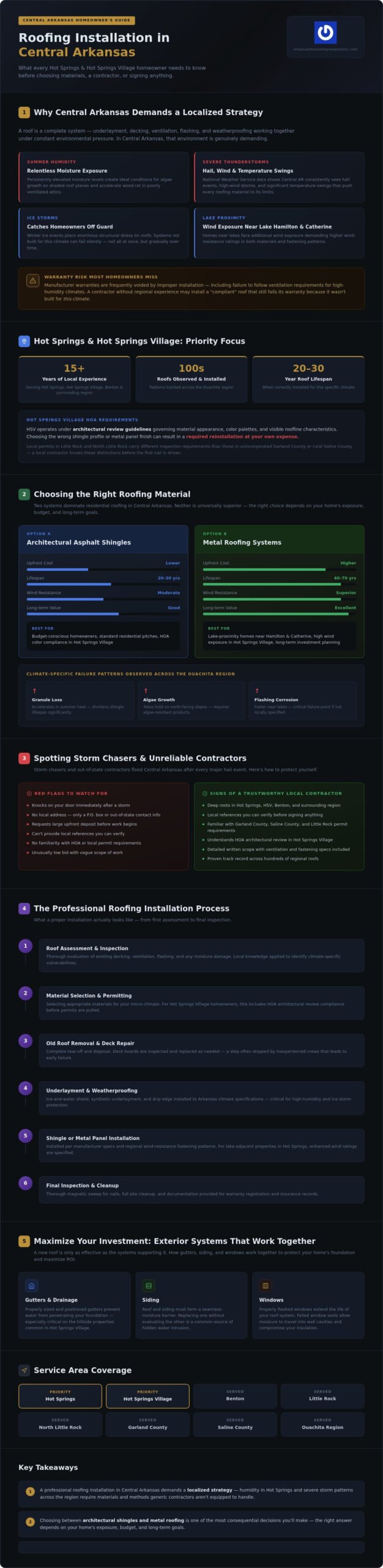
The Step-by-Step Professional Roofing Installation Process
Knowing what to expect before a crew arrives at your home changes everything. Anxiety fades when you understand the sequence. A professional roofing installation in Central Arkansas follows a deliberate, stage-by-stage process, and each phase has a specific purpose that protects both your home and your investment.
Protecting Your Property During Construction
Before a single shingle is touched, the job site is prepared. For homes in Hot Springs Village’s gated sections, that means coordinating with the community’s entry requirements, confirming crew access windows, and respecting the tighter lot clearances that many Village properties have. Landscaping beds, shrubs, and driveways take the brunt of roofing debris if no one’s paying attention. The Arkansas Home Improvement team places protective tarps around the full perimeter of the home before tear-off begins, shielding flower beds, HVAC equipment, and hardscaping from falling material.
Debris management doesn’t stop at tarps. Once the tear-off is complete, a magnetic roller sweeps the driveway, lawn edges, and walkways for nails. It’s a step that most homeowners never see and only notice when it’s skipped. Scheduling also accounts for Central Arkansas weather. Spring and summer storms can materialize quickly across Garland and Saline Counties, and experienced crews monitor forecasts closely to avoid leaving a home in an exposed state overnight.
The Critical Inspection Points
Tear-off reveals the full story of a roof’s history. Once old layers are removed, the decking is inspected board by board for soft spots, rot, and structural compromise. Homes near Lake Hamilton and the wetter hollows around Hot Springs Village often show moisture damage that wasn’t visible from the surface. Any compromised decking is replaced before the next phase begins. No exceptions.
The dry-in phase follows. High-quality underlayment is rolled across the entire deck, creating a watertight barrier that protects the home even if final installation is interrupted. Flashing is then set at every critical transition point: valleys, chimneys, skylights, and roof-to-wall junctions. These are the areas where water infiltration starts, and they require precise, experienced hands to seal correctly.
Attic ventilation gets a dedicated check at this stage. Arkansas summers drive attic temperatures to extremes, and a roof system without balanced intake and exhaust ventilation traps that heat, shortening the life of the materials above it and driving up cooling costs below. Getting ventilation right during installation is far less expensive than correcting it afterward.
Steve personally conducts a quality-control walk-through once installation is complete, reviewing fastening patterns, ridge cap alignment, flashing seals, and overall workmanship before the job is considered finished. The crew then performs a final site cleanup, leaving the property in better condition than they found it.
- Perimeter tarps placed before any tear-off begins
- Magnetic nail sweep across all paved and lawn surfaces
- Full decking inspection with replacement of any compromised boards
- High-performance underlayment installed during the dry-in phase
- Flashing set at all valleys, chimneys, and wall transitions
- Attic ventilation verified for Arkansas climate performance
- Final quality-control walk-through before project sign-off
Every stage of this process is designed to protect you long after the crew leaves. Talk to the Arkansas Home Improvement team about scheduling your installation and see what a structured, accountable process looks like from start to finish.
Maximizing Your Investment: Comprehensive Exterior Solutions
A high-quality roofing installation in Central Arkansas is a significant achievement, but it shouldn’t be viewed in isolation. Think of your home’s exterior as a protective envelope. While the roof sheds water, other systems must manage that runoff and protect the structural integrity of your walls and foundation. Neglecting these supporting systems can lead to premature wear on your new roof and costly repairs elsewhere. A holistic approach ensures that every dollar spent on your exterior contributes to long-term stability.
Integrating Gutters and Siding
Your roof’s best partner is a professionally installed Gutter System. Without efficient gutters, water pours off the roof edges, saturating the ground near your foundation and rotting the fascia boards that support your roofline. In the wooded lots of Hot Springs Village, where leaf debris is a constant challenge, heavy-duty gutters are essential to prevent water from backing up under your shingles. Matching your gutters and siding to your new roof creates a cohesive, intentional look that defines the aesthetic standards of the region.
When you align roofing with new siding and energy-efficient windows, the transformation is more than cosmetic. It’s a total performance upgrade. A sealed exterior envelope reduces the strain on your HVAC system during the peak of a Little Rock summer. This holistic approach to Exterior Home Improvement in Arkansas doesn’t just provide peace of mind; it significantly boosts your home’s resale value in a competitive market. Buyers notice when a home has been maintained as a complete system rather than a series of patchwork repairs.
Planning for long-term comfort also involves looking at the ground level and power reliability. Curb appeal is often finalized with professional sod service, ensuring your yard matches the quality of your home’s new exterior. Many homeowners in rural Central Arkansas now integrate home generators during their exterior remodel to ensure they’re never left in the dark during severe storm seasons. These additions turn a standard renovation into a comprehensive lifestyle upgrade that protects your family’s comfort.
Your Next Steps for a Secure Home
The first step toward a more durable home is a professional evaluation. When you sit down with Steve and the team, you aren’t just getting a quote; you’re getting a master plan for your property. We’ll walk through your current issues, discuss material options that fit your neighborhood’s character, and provide a clear timeline for the project. Whether you’re in the heart of Hot Springs or the outskirts of Benton, local accountability is our priority. We take pride in being the steady hand that guides you through the process.
For more insights into regional standards and reliable service, Willis and Son Roofing remains a trusted resource for homeowners seeking clarity in the industry. Your home is likely your largest investment. Protecting it with a coordinated roofing installation in Central Arkansas ensures it remains a safe, beautiful sanctuary for decades to come. Let’s build something that lasts.
Secure Your Home with Confidence
A durable roof is your home’s first line of defense against the unpredictable weather of the South. By choosing the right materials and ensuring your roofing installation Central Arkansas is handled by experienced hands, you’re protecting your family and your investment for decades. Quality matters. A professional installation is a complete system that includes proper ventilation, high-quality underlayment, and functioning gutters to prevent long-term foundation issues.
Steve and the team at Arkansas Home Improvement bring over 15 years of local experience to every project. We understand the specific standards of Hot Springs Village and the unique climate challenges of the Ouachita region. Our A+ rated local craftsmanship is built on a foundation of honesty, direct communication, and a commitment to a job well done. Whether you’re in the heart of Hot Springs or the surrounding areas of Benton and Little Rock, we’re ready to help.
Get Your Free Central Arkansas Roofing Estimate from Steve Today!
You don’t have to face your next home improvement project alone. We’re here to provide the steady hand and local expertise you need to move forward with peace of mind. Let’s get to work.
Frequently Asked Questions About Roofing Installation in Central Arkansas
How Long Does a Typical Roofing Installation Take in Central Arkansas?
Most residential roofing installations in Central Arkansas are completed in one to three days, depending on the size of the home, the pitch of the roof, and the material being installed. A standard single-story home with architectural shingles typically wraps up in a single full day. Larger properties, particularly the estate-style homes common in Hot Springs Village, or projects involving metal roofing systems, may extend to two or three days.
Weather is always a variable. Spring and summer storm patterns across Garland and Saline Counties can push timelines by a day, and experienced crews build that flexibility into their scheduling rather than rushing through conditions that compromise quality. Steve and the Arkansas Home Improvement team will give you a realistic timeline before work begins, not an optimistic one.
Can I Install a New Roof Over My Old Shingles in Arkansas?
Arkansas building codes generally permit one layer of new shingles to be installed over an existing layer, but it’s rarely the right choice. Layering adds significant weight to your roof structure and, more importantly, it conceals the decking beneath. Any rot, soft spots, or moisture damage underneath stays hidden and continues to worsen. A full tear-off is almost always the more responsible approach.
For homes near Hot Springs and the wetter hollows around Hot Springs Village, where moisture infiltration is a persistent concern, skipping the decking inspection is a risk that tends to surface as a costly repair within a few years. A complete installation that starts with a clean, inspected deck protects your investment far more effectively than a shortcut that saves a little upfront.
What Is the Best Roofing Material for the Hot Springs Climate?
There’s no single answer, but the Hot Springs climate does narrow the field. The combination of persistent humidity, elevated UV exposure, and frequent severe storm events makes material quality non-negotiable. For homeowners prioritizing value and proven performance, architectural shingles with algae-resistant coatings and Class 3 or Class 4 impact ratings are a strong baseline choice. Lighter color tones also help manage heat absorption through long Arkansas summers.
For lakefront properties near Lake Hamilton or Lake Catherine, and for the exposed hilltop homes throughout Hot Springs Village, metal roofing earns serious consideration. Its resistance to wind, hail, and moisture, combined with a lifespan that can reach 40 to 50 years, makes it a genuinely different category of investment. The right choice depends on your home’s specific exposure and your long-term ownership plans.
Do You Handle Roofing Permits for Hot Springs Village?
Yes. Navigating the permit and architectural review process in Hot Springs Village is something Arkansas Home Improvement handles as a standard part of every project. The community’s architectural guidelines govern material appearance, color palettes, and visible roofline characteristics, and submitting the wrong specifications can result in a required reinstallation at your own expense. We know those requirements before the first nail is driven.
Permit requirements in unincorporated Garland County and in the city of Hot Springs also differ from those in Little Rock, North Little Rock, and Benton. A contractor with 15 years of active work across this region manages those distinctions without putting the burden on the homeowner to figure them out mid-project.
How Do I Know If My Roof Has Hail Damage After an Arkansas Storm?
Hail damage on asphalt shingles often isn’t visible from the ground. The most reliable indicators are circular impact marks on shingles where granules have been displaced, leaving a darker, exposed patch beneath. You may also notice dents on metal components like gutters, downspouts, or flashing, which are easier to spot and confirm that hail of sufficient size did hit your property.
Don’t wait for an interior leak to confirm the damage. By the time water appears on your ceiling, the underlying issue has typically been developing for some time. After any significant hail event across Central Arkansas, a professional inspection is the fastest way to establish whether damage exists, document it accurately for your insurance carrier, and determine whether a roofing installation or targeted repairs are the appropriate next step.
Does a New Roof Really Improve My Home’s Energy Efficiency?
It does, and the impact is more meaningful than most homeowners expect. A roofing installation in Central Arkansas that includes proper attic ventilation, high-performance underlayment, and reflective or light-toned shingles directly reduces the heat load transferred into your living space during peak summer months. Attic temperatures in Little Rock and Benton homes can climb dramatically through July and August, and a roof system that manages that heat keeps your cooling system from working harder than it needs to.
Metal roofing amplifies this benefit considerably. Its natural ability to reflect solar radiation rather than absorb it makes a measurable difference in homes that experience long sun exposure. That efficiency advantage compounds over years of ownership, contributing real value beyond the roof’s structural function.
What Kind of Warranty Comes With a Professional Roofing Installation?
A properly documented roofing installation typically carries two distinct warranties: one from the material manufacturer covering the shingles or metal panels themselves, and a separate labor warranty from the installing contractor covering workmanship. These are not the same thing, and understanding both before you sign anything is important. Manufacturer warranties on quality architectural shingles commonly range from 30 years to lifetime coverage, with specific terms that vary by product line.
Labor warranties vary significantly by contractor. Arkansas Home Improvement’s 15-year history in the region means warranty claims are handled by a company that will still be here when you need them, not one that relocated after the storm season ended. Ask any contractor you’re evaluating to state their labor warranty terms in writing, separately from the manufacturer’s documentation, before work begins.
How Do I Prepare My Home and Yard for the Roofing Crew?
A few simple steps before the crew arrives make the process smoother for everyone. Move vehicles out of the driveway and away from the home’s perimeter to give the crew clear access and protect your car from falling debris. If you have fragile potted plants, outdoor furniture, or decorative items near the roofline, relocate them temporarily. Inside, take down any wall art or items on shelves directly below the roofline, as vibration from tear-off can shake them loose.
The Arkansas Home Improvement team handles the heavy preparation on their end, including perimeter tarps and a magnetic nail sweep after tear-off. For Hot Springs Village properties, it’s also worth confirming gate access codes and any community entry requirements with the crew in advance so there are no delays on installation day. A quick conversation before the project starts prevents the small friction points that slow things down.