The lowest bid for your home’s exterior in Hot Springs might actually be the most expensive mistake you make this year. When you’re looking at the vinyl siding vs fiber cement cost Arkansas homeowners face in 2026, the price tag on the estimate is only half the story. We know you want a home that stands up to our intense humidity and unpredictable weather without constantly draining your savings on repairs or mold remediation. Whether you live in Hot Springs Village or the heart of Little Rock, choosing the right material is about protecting your largest investment for the next few decades.
It’s stressful to manage a renovation when material prices are shifting, and we agree that you deserve total transparency before you sign a contract. This guide provides a clear comparison of installation expenses, durability against Central Arkansas hail, and the long-term ROI of each option. You’ll learn exactly how these materials perform in our climate and which choice offers the best stability for your family’s future. We’ve simplified the data so you can move forward with confidence and peace of mind.
Key Takeaways
- Learn how the vinyl siding vs fiber cement cost Arkansas homeowners face in 2026 is shaped by local labor demands and rising material prices.
- Discover which siding material offers the best defense against the high humidity and seasonal hail storms specific to Hot Springs and Hot Springs Village.
- Compare the long-term return on investment to see how choosing a premium material can significantly increase your home’s resale value in Central Arkansas.
- Get the facts on the “zero-maintenance” myth and understand the actual upkeep required to keep your exterior looking new for 30 years or more.
- Find out why partnering with a local expert for your siding services provides better warranty protection and craftsmanship tailored to our regional climate.
Understanding Siding Costs in Arkansas for 2026
Starting your home renovation in 2026 feels different than it did just a few years ago. Supply chains have stabilized; however, the costs of raw materials and skilled labor have established a new baseline. When you evaluate the vinyl siding vs fiber cement cost Arkansas homeowners are seeing right now, you’re looking at more than just a number on a page. You’re looking at a long-term investment in your property’s protection. At Arkansas Home Improvement, we prioritize transparency because we know that surprises are the last thing you want during a remodel. Whether you’re updating a lakefront home in Hot Springs or a classic residence in North Little Rock, understanding the current market is your first step toward a successful project.
Material choice is the single largest driver of your renovation budget. It dictates everything from the initial purchase price to the complexity of the installation process. It’s helpful to distinguish between the “sticker price” of various siding materials and the actual “installed cost.” The latter includes the specialized tools, fasteners, and safety equipment required for a professional job. For homeowners in the Little Rock metro and surrounding areas, these differences can amount to thousands of dollars in your final estimate.
The Economic Landscape of Arkansas Home Improvements
Inflation in 2026 continues to impact the manufacturing of both vinyl and fiber cement. While vinyl remains a popular, cost-effective choice, its price is tied to global resin markets. Fiber cement production is more energy-intensive, which reflects in its premium pricing. Regional labor availability also influences your bottom line. In Hot Springs and Hot Springs Village, the demand for high-quality craftsmanship often outpaces the supply of available crews. We focus on maintaining local expertise to reduce the risk of mid-project cost overruns. This local focus ensures that our teams are ready to work without the logistical delays or travel fees often associated with outside contractors.
Hidden Factors Influencing Your Siding Quote
A professional quote from our Siding Services team accounts for every detail, including the factors that aren’t immediately visible. These hidden elements can shift a budget if they aren’t identified early in the consultation process. Consider these common variables:
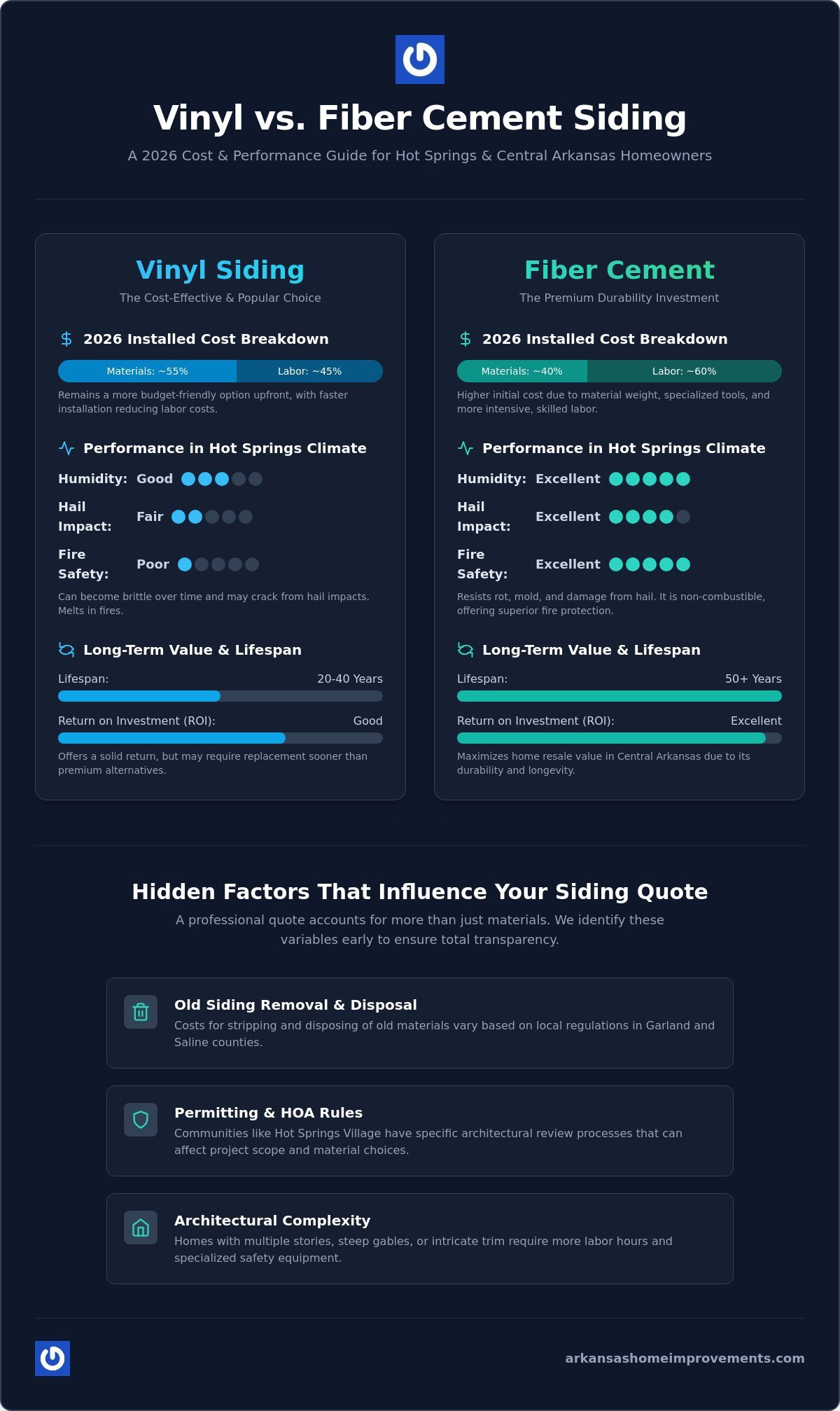
- Removal and Disposal: Fees for stripping old siding vary based on local landfill regulations in Garland and Saline counties.
- Permitting and HOA Rules: If you live in Hot Springs Village or Benton, specific architectural review committees may have requirements that affect your project’s scope.
- Architectural Complexity: Homes with multiple stories, steep gables, or intricate window trim require more labor hours and specialized safety equipment.
By identifying these factors early, we help you avoid the stress of unexpected expenses. Our goal is to provide a clear, honest assessment that respects your budget while ensuring your home in Central Arkansas stays beautiful and protected for years to come.
Vinyl vs. Fiber Cement: A Detailed Material & Labor Breakdown
Choosing between these two options requires a look at the total project scope. When calculating the vinyl siding vs fiber cement cost Arkansas homeowners should expect, the raw material price is just the starting point. Fiber cement boards are significantly heavier and more rigid than vinyl panels. This physical difference changes the entire installation process. It requires specialized cutting tools, specific fasteners, and larger crews to handle the weight safely. While vinyl installation focuses on speed and flexibility, fiber cement demands precision and structural expertise. These factors directly influence the final investment required for your home’s exterior.
In the 2026 market, labor accounts for a larger portion of your total investment than ever before. For a standard vinyl project, labor typically represents 40% to 50% of the total cost. In contrast, fiber cement installation is more labor-intensive, with labor often making up 55% to 65% of the bill. This is because fiber cement is the fastest-growing siding segment for premium renovations, requiring crews that understand its weight and specific cutting requirements. If you’re looking for a detailed 2026 siding cost and material comparison, these labor ratios are the most critical data points to track. The specialized equipment needed for fiber cement, such as dust-collecting saws and high-gauge nailers, also adds to the professional nature of the installation.
Vinyl Siding Cost Expectations
Vinyl remains the most popular budget-friendly choice in Cabot and Malvern because it offers a clean look without a massive upfront investment. Standard vinyl is widely available and installs quickly, which keeps labor costs on the lower end of the spectrum. However, many homeowners are now looking at premium insulated vinyl. This option carries a higher price bump but provides better impact resistance and potential energy savings. To ensure your home stays efficient inside and out, you can learn more about Caribbean Heating & Cooling for professional HVAC services. While it narrows the price gap between vinyl and fiber cement, it still doesn’t require the same level of specialized labor as heavier materials.
Fiber Cement Investment
Investing in fiber cement for a home in Hot Springs or Hot Springs Village is a choice for longevity. Why are material costs higher in 2026? A shift towards more durable, climate-resistant materials has increased demand for these premium boards. We call the price difference the “Specialist Premium.” You shouldn’t hire a generalist for this work because improper fastening can void warranties and lead to moisture issues. A total project estimate for a Hot Springs home will reflect the need for a seasoned crew that knows how to handle the material’s weight and the specific layout of our local architecture. For a clearer picture of how these materials fit your budget, consider scheduling a local property assessment with our team.
Ultimately, the choice depends on your long-term goals. If you plan to stay in your home for decades, the higher labor investment of fiber cement often pays for itself through increased durability. If you need a reliable, attractive update that fits a tighter budget, our Siding Services for vinyl remain a top-tier choice for many Central Arkansas families.
The Arkansas Climate Test: Durability in Hot Springs and Beyond
Arkansas weather doesn’t take it easy on your home’s exterior. From the sweltering July heat in Little Rock to the sudden hail storms that sweep through Garland County, your siding choice is your first line of defense. When weighing the vinyl siding vs fiber cement cost Arkansas homeowners often ask if the extra investment is purely for looks. The truth is that our local climate tests these materials in very different ways. Choosing the right one means understanding how they react to the specific environmental stressors found in Hot Springs and Hot Springs Village.
Durability is a major factor in long-term value. According to the Consumer Reports siding buying guide, material performance varies widely based on impact resistance and weather exposure. In Central Arkansas, sun exposure is a constant battle. Standard vinyl can sometimes lose its luster or become brittle over decades of intense UV exposure. Fiber cement, while requiring a higher initial cost, often holds its color longer and provides a much sturdier barrier against the elements. If you’re concerned about pests, especially in the wooded lots of Hot Springs Village, fiber cement offers a distinct advantage because it’s unappealing to termites and woodpeckers alike.
Storm Performance in Central Arkansas
Storm season brings the threat of hail and high winds. Fiber cement is a heavy, dense material that offers superior impact resistance compared to standard vinyl. This is a critical consideration for homes near Lake Hamilton, where wind loads can be higher during severe weather. If you’re in a heavily wooded area, fiber cement’s non-combustible nature provides an extra layer of peace of mind. While vinyl is durable, it’s more prone to cracking under the force of large hail. We often see this lead to secondary issues like water intrusion if the damage isn’t caught quickly and addressed.
Humidity and Thermal Expansion
Little Rock’s temperature swings are notorious for causing “vinyl rattle.” Because vinyl expands and contracts significantly as the temperature changes, it must be installed loosely. If it’s nailed too tight, it will buckle. Fiber cement is much more dimensionally stable; it stays in place regardless of the humidity. However, the humid Arkansas climate makes moisture management vital for both materials. A high-quality house wrap is just as important as the siding itself to prevent mold and mildew from taking hold behind your new boards. Our Siding Services prioritize these moisture barriers to ensure your home stays dry and healthy for the long haul.
Maintenance, Lifespan, and ROI for Central Arkansas Homeowners
Calculating the true vinyl siding vs fiber cement cost Arkansas homeowners face requires looking past the initial installation date. While your upfront budget is important, the expenses you’ll encounter over the next fifteen to thirty years determine the actual value of your investment. Each material follows a different aging process in our local environment. Choosing between them is a balance of immediate affordability and the long-term cost of ownership. At Arkansas Home Improvement, we want you to feel confident that your choice today won’t become a financial burden a decade from now.
The lifespan of these materials varies significantly under the stress of Arkansas weather. Vinyl siding typically lasts between 20 and 40 years; however, it can become brittle and prone to cracking as it nears the end of its life. Fiber cement is a much more permanent solution, with a lifespan often exceeding 50 years. This longevity is why it’s the fastest-growing segment for premium renovations in Hot Springs and surrounding areas. This durability comes with specific maintenance responsibilities that you must factor into your total budget.
Annual Maintenance Requirements
Many homeowners are drawn to vinyl because of the “zero-maintenance” myth. In reality, vinyl requires regular cleaning to prevent Arkansas red dirt from staining the lower panels. A simple wash with soap and water usually does the trick. Fiber cement requires a bit more vigilance. It must be repainted every 10 to 15 years to maintain its moisture resistance and aesthetic appeal. Based on 2026 industry data, repainting a typical home can cost between $3,000 and $8,000. If you live in Hot Springs Village, your HOA may have strict guidelines on how often your exterior must be refreshed, making these maintenance cycles even more critical to your planning.
Return on Investment (ROI) Analysis
When it’s time to sell, your siding choice directly impacts your home’s appraisal and time on the market. In competitive areas like Benton and Bryant, curb appeal is a major driver of buyer interest. As of March 2026, fiber cement offers a projected ROI of 114% at resale. Vinyl siding still performs well, with a projected ROI of 77% as of March 2026. For homeowners in Little Rock, a high-quality exterior often leads to a faster sale because buyers recognize the value of a durable, well-protected home. You can find more details on how we create integrated exterior value through our comprehensive installation standards. To see which material offers the best financial return for your specific property, request a personalized ROI assessment today.
Choosing Your Ideal Siding with Arkansas Home Improvement
Deciding on the right exterior is a major milestone for any homeowner. You’ve seen the data on the vinyl siding vs fiber cement cost Arkansas market, and now it’s time to apply those insights to your specific property. At Arkansas Home Improvement, we don’t believe in one-size-fits-all solutions. Our consultative approach focuses on your long-term goals, whether you’re looking for the maximum resale value in Hot Springs or a budget-conscious update in Benton. We take pride in being a steady, experienced hand that guides you through the complexities of material selection and installation.
Local presence provides a level of accountability that out-of-state contractors simply can’t match. Our deep roots in the community mean we’re familiar with the architectural nuances of Hot Springs Village and the specific weather patterns of Garland County. If you ever have a question about your warranty or need a follow-up inspection after a major storm, you know exactly where to find us. We also understand how your siding works in tandem with other systems. Combining our Siding Services with professional Roofing Installation or Gutter Installation Services ensures your home has a seamless, high-performance envelope against the Arkansas elements.
The Arkansas Home Improvement Difference
Our commitment to Hot Springs and Hot Springs Village residents goes beyond just providing an estimate. We’ve spent years mastering the installation techniques for both vinyl and fiber cement to ensure every joint is tight and every board is secure. For a broader look at how we approach residential upgrades, you can explore our Exterior Home Improvement Arkansas roundup. This dedication to quality mirrors the standards set by established firms like Long Island Windows and Siding, and our expertise allows us to handle everything from historic Little Rock renovations to modern builds in Bryant with the same level of professional energy and attention to detail.
Next Steps for Your Siding Project
Starting your project is a straightforward process designed to give you total peace of mind. We follow a logical progression to ensure no detail is overlooked:
- Step 1: Schedule a professional local assessment. We’ll visit your home to identify any underlying structural needs and provide an accurate, no-obligation quote for your specific zip code.
- Step 2: Compare material samples in the Arkansas sun. We bring samples directly to your door so you can see how different textures look against your home’s actual lighting and landscape.
- Step 3: Review a comprehensive project timeline and budget. You’ll receive a clear roadmap that outlines exactly when our crews will arrive and how we’ll protect your property during the transformation.
Your home is your most valuable asset, and it deserves a protective layer that lasts for decades. We’re ready to help you find the perfect balance of beauty, durability, and cost-effectiveness for your Central Arkansas home.
Secure Your Home’s Future with Confidence
Choosing the right exterior is about more than just matching a color palette; it’s about ensuring your property can withstand the unique challenges of our Central Arkansas climate. You now have the data to navigate the vinyl siding vs fiber cement cost Arkansas homeowners face in 2026. Whether you prioritize the high ROI and storm resistance of fiber cement or the reliable affordability of vinyl, your decision defines your home’s protection for decades. Our team brings 15+ years of Arkansas craftsmanship to every project, providing specialized local expertise in Hot Springs Village and the surrounding areas.
At Arkansas Home Improvement, we take immense pride in delivering A+ rated exterior solutions that offer stability and peace of mind. We’re here to help you move forward with honest advice and a commitment to quality. When you’re ready to start your transformation, we invite you to Request Your Free Arkansas Siding Quote Today. Let’s work together to create a beautiful, durable home that stands strong against the elements in Hot Springs and beyond. Your vision for a better home is within reach, and we’re honored to help you achieve it.
Frequently Asked Questions
How much more does fiber cement cost than vinyl in Arkansas?
Fiber cement typically requires a higher initial investment than vinyl because the materials are heavier and the installation is more labor-intensive. In the 2026 market, labor accounts for a larger portion of the total bill for fiber cement projects. This is due to the specialized tools and larger crews needed to handle the rigid boards safely. While vinyl is more budget-friendly upfront, fiber cement offers a different value proposition through its extended lifespan and durability.
Does vinyl siding hold up well in the Hot Springs heat?
Modern vinyl siding performs well in the Hot Springs heat as long as it’s installed by professionals who understand thermal expansion. Because vinyl expands and contracts significantly during our intense July summers, it must be hung loosely on the nails. If it’s fastened too tightly, the panels can buckle or warp. Our crews ensure that your siding has the necessary room to move, preventing the common “vinyl rattle” and keeping your exterior smooth.
Is James Hardie siding worth the extra investment for an Arkansas home?
For many residents in Hot Springs Village, the long-term benefits of fiber cement outweigh the higher initial cost. It offers superior resistance to the pests and fire risks often found in our wooded communities. When you consider the 114% return on investment at resale, it’s a strategic choice for protecting your home’s value. It provides a level of structural stability and aesthetic appeal that standard materials often can’t match over several decades.
How long does siding installation take for a house in Little Rock?
A typical siding replacement for a home in the Little Rock metro usually takes between seven and fourteen days. The exact timeline depends on the size of your house and the material you choose. Vinyl installation is generally faster because the panels are lightweight and easier to cut. Fiber cement takes more time because each board requires precise measurements and specialized cutting equipment to ensure a perfect fit and long-lasting moisture protection.
Can I install fiber cement siding over my existing wood siding?
We strongly recommend removing your old wood siding before installing new fiber cement boards. This allows our team to inspect your home’s sheathing for any hidden rot or moisture damage that is common in our humid climate. A clean, flat surface is essential for a professional finish and ensures that your new siding meets all manufacturer warranty requirements. Starting with a fresh surface provides the best long-term stability for your home’s exterior.
What is the best siding for hail protection in Central Arkansas?
Fiber cement is the top choice for hail protection because its dense composition resists impacts much better than standard vinyl. During the volatile storm seasons in Central Arkansas, large hail can crack or chip thinner materials. This durability is a major factor in the vinyl siding vs fiber cement cost Arkansas debate. If you live in an area prone to severe weather, the peace of mind that comes with a high impact resistance rating is often worth the premium.
Does Arkansas Home Improvement offer financing for siding projects?
We encourage you to contact our office directly to discuss the most current options for managing your project budget. Every home renovation is unique, and we’re committed to providing transparent, honest assessments that respect your financial goals. Our team can walk you through the quote process and help you plan a timeline that works for your family. We prioritize clear communication so you can move forward with your exterior upgrade without unnecessary stress.
How often do I need to repaint fiber cement siding in the Arkansas climate?
You can expect to repaint fiber cement siding every 10 to 15 years to keep it looking its best and maintain its moisture resistance. The intense Arkansas sun can eventually cause even high-quality finishes to fade. Regular maintenance, such as checking the caulking around windows and doors, helps extend the life of your paint job. This repainting cycle is a standard part of owning a fiber cement home and ensures your property maintains its premium curb appeal.